Net Metering in Edmonton

How does net metering actually work in Edmonton?

5.0 · 70+ five-star Google reviews

Written by Dmitry Naboka · Master Electrician #13824 · Raydn Renewables, Edmonton · Last updated July 2026.

I eat my own cooking, right here in Edmonton

Net metering, on my own roof: last month my account came back a credit.

This is my house in Edmonton, not a brochure.

  • The system

    A 9.56 kW system across four roof faces

  • The billing period

    From May 5 to June 2, 2026

  • What it exported

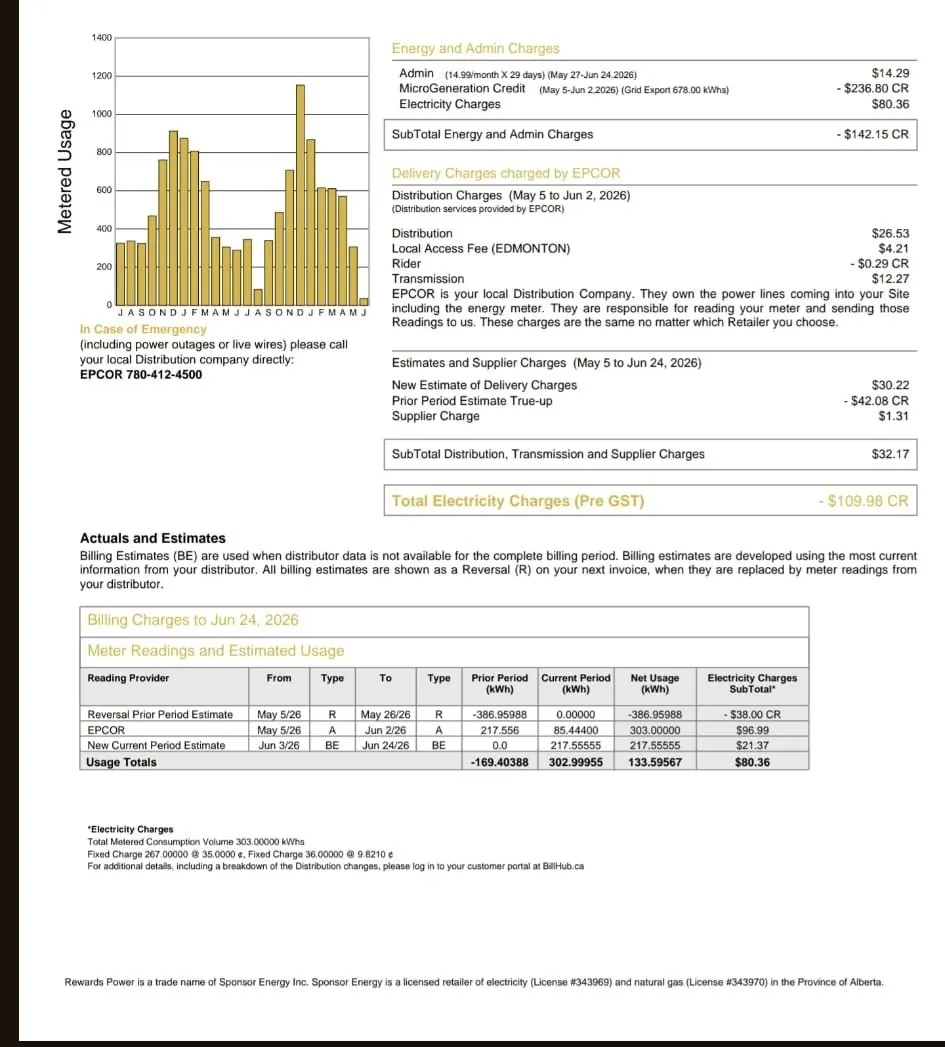
    I exported 678 kWh more than I used

  • What came back

    my retailer sent me a credit, and that credit then covered my gas bill too

I would not sell a system I would not put on my own roof, so here is the actual bill.

$236.80 Power my roof generated, one month
~35¢/kWh Export rate on Rewards Power
-$109.98 Net bill, after all grid fees
Read my summer bills · 2 min

Source: my own power bill, May to June 2026 billing period. $236.80 microgeneration credit for 678 kWh exported, less $126.82 in energy and fixed grid charges, nets to negative $109.98. Rewards Power is our referral partner; the export rate is what makes the generated number this high.

Power bill for my house in west Edmonton, May to June 2026, showing a negative $109.98 credit balance from a 9.56 kW solar install -$109.98 CR Read the whole bill →
Owner’s real bill · Edmonton · May to June 2026

Net metering, in plain English

Think of the grid as a giant battery you never pay to install. You put power in when the sun is up, you take it back out at night, and EPCOR keeps the tab. That tab is net metering.

Which direction power flows through a bi-directional meter on an Edmonton home Sun is up: the array runs the house and the surplus leaves through the meter as an export credit. Your panels Your home EPCOR grid Two way meter

Sun is up. The meter runs backward.

Your house gets served first, straight off the roof. Whatever is left leaves through the meter and your retailer credits it. You are not storing anything. The grid is doing the storing for you, and you never paid to install it.

Tap any heading to open it. Nothing is hidden, it is just folded.

The part nobody explains: you sell high and buy low

Here is where the real money hides. You sell your solar power to the grid at 35 cents a kilowatt-hour, then buy it back at 5.90 cents. You keep the spread. That is not a typo, and it is the whole reason a properly wired Edmonton system pays for itself faster than people expect.

The honest detail: Solar Club is a two tier plan.

High season tier

35.00

cents

that 35 cent figure is the high tier of a two tier Solar Club plan.

Low season tier

5.90

cents

The low tier is 5.90 cents, and in the low season that is what you pay coming in and what you earn going out.

And which tier applies depends on the season and how the plan is set up. Both figures come off the Solar Club July 2026 fact sheet, read 26 August 2026.

We size and model your system on your actual rate, not the headline one, so the number you see is the one you will live with.

You sell

35¢ per kWh

Solar you export to the grid on a sunny day, credited through the Reward Power Solar Club at a premium export rate.

You buy

5.90¢ per kWh

Power you pull back from the grid at night or on a grey day, at the normal supply rate.

You keep

The spread

Roughly 29.1¢ on every kilowatt-hour you bank in summer and spend in winter. That gap is what runs a bill negative.

How the credits show up on your bill

771 kWh left my house that month

Line 1 of 4

That is one cycle, 3 June to 2 July, off a 9.56 kW system on four roof faces in Edmonton. Credited at 35.0 cents a kilowatt-hour on my statement. Not a projection and not a brochure figure. It is the number the retailer settled.

Every figure here is a line off my own settled statement, not a model. See the statements.

Summer

You bank a surplus

Long days, high production. You export far more than you use and your account carries a credit into the darker months.

Winter

You spend the credit

Short days, lower production. You draw from the grid, and the summer credits you banked cover the gap.

Year

It balances out

Sized right, a full year of production cancels a full year of energy charges. That is the target, not a single perfect month.

The export rate is a choice, so choose it well

EPCOR owns the wires and the meter. Your retailer sets the rate you get paid for exports, and that rate is not one-size-fits-all. Picking the right plan is real money.

1

Match-rate plans

Some retailers credit exports at the same rate you buy power for. Simple and often the strongest for a well-sized system.

2

Fixed export-rate plans

A set cents-per-kWh credit for what you send back. Predictable, sometimes lower than your buy rate.

3

Pool-price plans

Your export credit floats with the Alberta pool price. Can pay well or poorly depending on the market. Not for everyone.

Once your system is live and we can see your real export profile, we help you line up your retailer plan so you are actually paid fairly for the power you push back. This is the step door-to-door crews skip, because they are gone the day the panels go up.

5.0 on Google · 70+ verified reviews

What solar customers say

★★★★★
“If you're considering solar, look no further than Raydn Renewables. Dima and his crew were professional, knowledgeable, and trustworthy from start to finish. From the moment he walked through the door, the service was handled with care and by the time the job was done, he hadn't just met my expectations, he'd blown past them. The whole team clearly takes pride in their work and genuinely cares about their customers. I felt confident every step of the way. If you're looking for a solar company you can actually trust, Raydn Renewables is it. Highly recommend!”
Keirnen · Verified Google review
★★★★★
“Had a great experience with Raydn Renewables. Dima and his team were friendly, professional, and easy to work with from start to finish. They answered all my questions, showed up when they said they would, and the installation was done quickly and looks awesome. You can tell they really care about doing quality work and making sure everything is done right. The whole process was way easier than I expected, and I never felt like they were trying to sell me something I didn't need. I'd definitely recommend Raydn Renewables to anyone looking for solar or electrical work. Really happy with the service!”
Jonah Kammermayer · Verified Google review

Swipe sideways for 1 more →

Read all reviews →

In Alberta it is called micro-generation, and it works like a running tab with EPCOR. Net metering is one gate out of five. The whole picture, approval through to the rate spread, is drawn out on the economics of solar page.

Summer

Bank

credits

Overproduce in summer and you bank credits.

Winter

Spend

credits

Draw power in winter and you spend them.

Here is exactly how the credits land on your bill, and how I size a system to cancel your energy charges across the whole year.

EDMONTON MICRO-GEN, 2026

Quick facts

  • What it is calledMicro-generation in Alberta, the local name for net metering
  • How you earnExport surplus solar to the grid, EPCOR credits your account
  • Export rateSet by your retailer, not the wires company. It is a lever worth choosing carefully
  • The seasonal trickSummer surplus banks credits to cover short winter days
  • Meter neededEPCOR bi-directional meter, arranged as part of the install
  • Honest caveatFixed delivery and admin fees remain even at net-zero energy

Honest Answers

The questions homeowners actually ask

From a Master Electrician's chair, not a salesperson's script.

How does net metering work in Edmonton?

In Alberta it is technically called micro-generation, and it works like a running tab with EPCOR. When your panels make more power than your house is using, the extra flows back through your meter to the grid and you earn a credit. When you pull power at night or in winter, you draw from the grid and pay for it. At the end of each billing period, the two are netted against each other. Overproduce and you carry a credit forward; underproduce and you pay the difference.

What rate do I get for exported solar in Alberta?

It depends on your electricity retailer, not EPCOR the wires company. Some retailers credit your exports at the same rate you buy power for, some pay a fixed lower rate, and some pay the floating pool price. This is one of the biggest levers on your savings, so once we can see your export profile we help you pick a retailer plan that pays you fairly for what you send back.

Do my solar credits expire?

Under Alberta's micro-generation framework, credits typically carry forward month to month within your account so summer overproduction can offset winter draw. The exact carryover and any annual reconciliation depend on your retailer's plan terms. This is precisely why we size Edmonton systems to the full year, banking summer surplus to cover the short, dark winter days.

How big a system do I need to zero out my bill?

To cancel your energy charges you size the system to your annual kWh usage, not a single month. A typical Edmonton family home lands somewhere around a 7 to 11 kW system, but it comes straight off your own power bill. Note that even at net-zero energy, fixed delivery and admin charges remain, which is why an honest quote never promises a literal zero-dollar bill.

Is net metering the same as a battery?

No. Net metering uses the grid as your battery, banking credits when you overproduce and drawing them back when you need power, with no physical storage on site. A home battery is separate hardware that stores your own power for outages or after-dark use. In Alberta, net metering handles most of the savings on its own, and a battery is added for resilience, not usually for the economics.

Do I need a special meter for net metering?

Yes. EPCOR installs a bi-directional meter that measures power flowing both ways, in and out of your home. Arranging that meter swap and filing the EPCOR Micro-Generation Agreement is part of what a proper installer handles for you. If a quote does not mention the Micro-Gen Agreement and the meter change, that is a red flag the paperwork is being skipped.

Your Credit Math

Want to see your own credit math?

Two ways to get your number.

Run it yourself

The calculator models your exports and credits using real EPCOR rates and your own usage.

Or call me

Or call me and I will size a system to your annual bill.

I handle the paperwork

I arrange the bi-directional meter and Micro-Gen Agreement, and help you pick a retailer plan that pays you fairly.

No battery required to run a negative bill.

Dmitry Naboka · Master Electrician #13824 · Raydn Renewables, Edmonton

The Solar Bermuda Triangle

Once the sun hits your panels, the energy never leaves.

Three points. Panels catch it. Your EV, heat pump, and every load in the house run on the sun. The battery stores the rest for anything you want later. Nothing escapes back to the grid unless you decide it should.

Solar Bermuda Triangle diagram Solar panels feed both house loads and battery storage. Energy circulates inside the triangle and does not leak back to the grid. Each vertex links to its calculator. 1  CATCH THE SUN Solar panels Battery bank 3  STORE THE REST EV & loads 2  DRIVE BY SUN
01

Panels catch the sun

  • On the roof

    All-black modules on your roof convert sunlight to DC

  • At the inverter

    The inverter flips it to AC

  • How we spec it

    We spec the right one for your roof, Enphase microinverters when it makes sense, SolarEdge or a solid string setup when it does not

No single brand quota, no single point of failure baked in where it does not belong.

60-second solar estimate →
02

EV & loads drive by sun

EV charger, heat pump, hot water tank, fridge, lights. Anything drawing power in the moment gets solar first. Your Tesla, F-150 Lightning, or Ioniq drives on sunlight, not the grid.

Size my EV load →
03

Battery stores it for anything

Whatever the house does not use goes straight to the battery bank. Powerwall, EP Cube, or Pylontech. Evenings, cloudy days, outages, EV charging, backup, or heavy loads. You spend that stored solar on your terms.

Size my battery bank →

The whole system is designed to keep every kilowatt inside the triangle. Once energy enters, it only leaves when you use it. That is what maximum self-consumption looks like, and it is why a Raydn design pays back faster than a grid-tie-only quote.

See EPCOR net-metering solar in Edmonton
Honest quote in 24 hours