The owner's own roof, since 2022
Four years live on my own house, zero panels down.
I did my own roof exactly the way I do yours, and it has run monitored every day since 2022. That is not a claim you have to trust.
A house you can drive to
A ladder I will set up
A roof you can climb onto and inspect for yourself
That is the single biggest flex I offer.
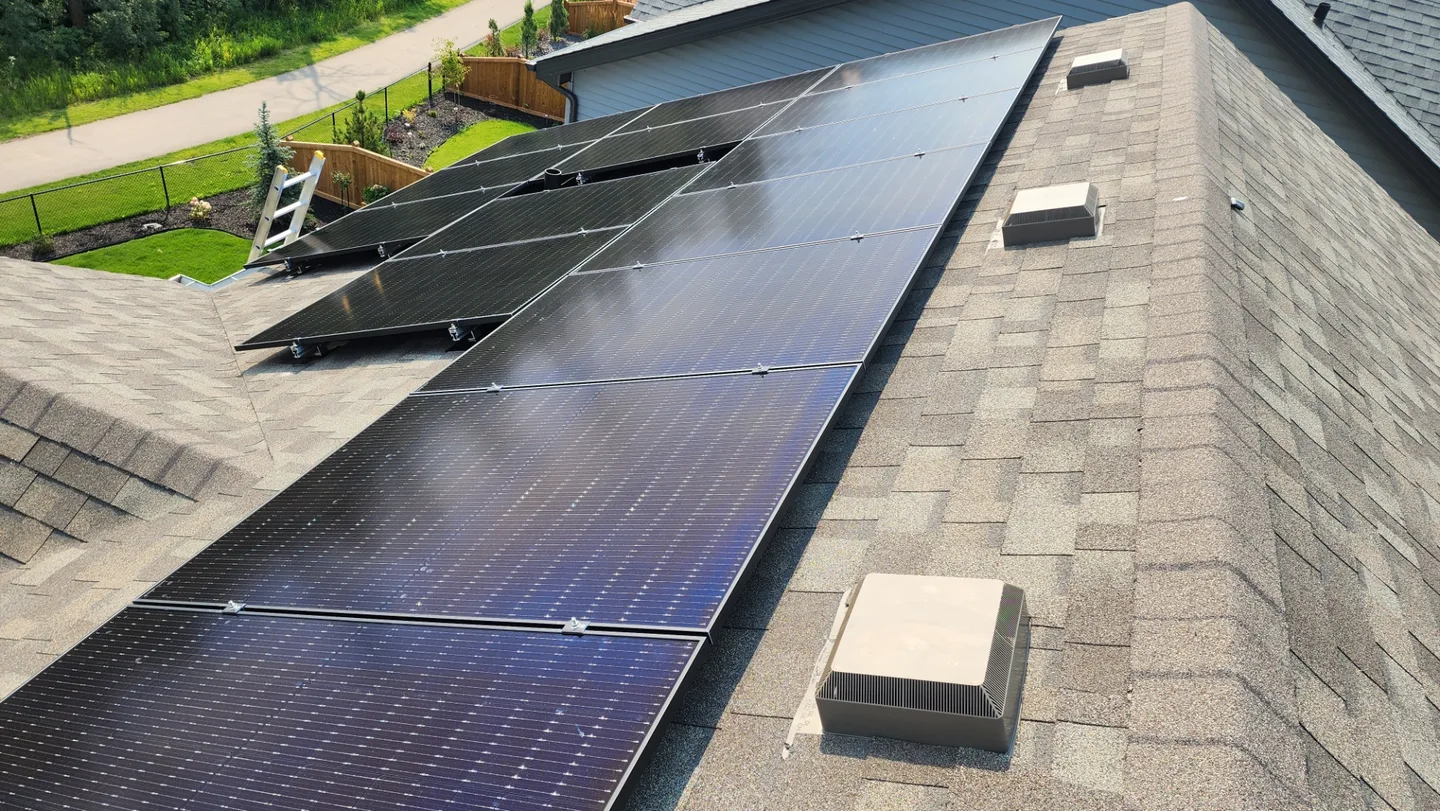
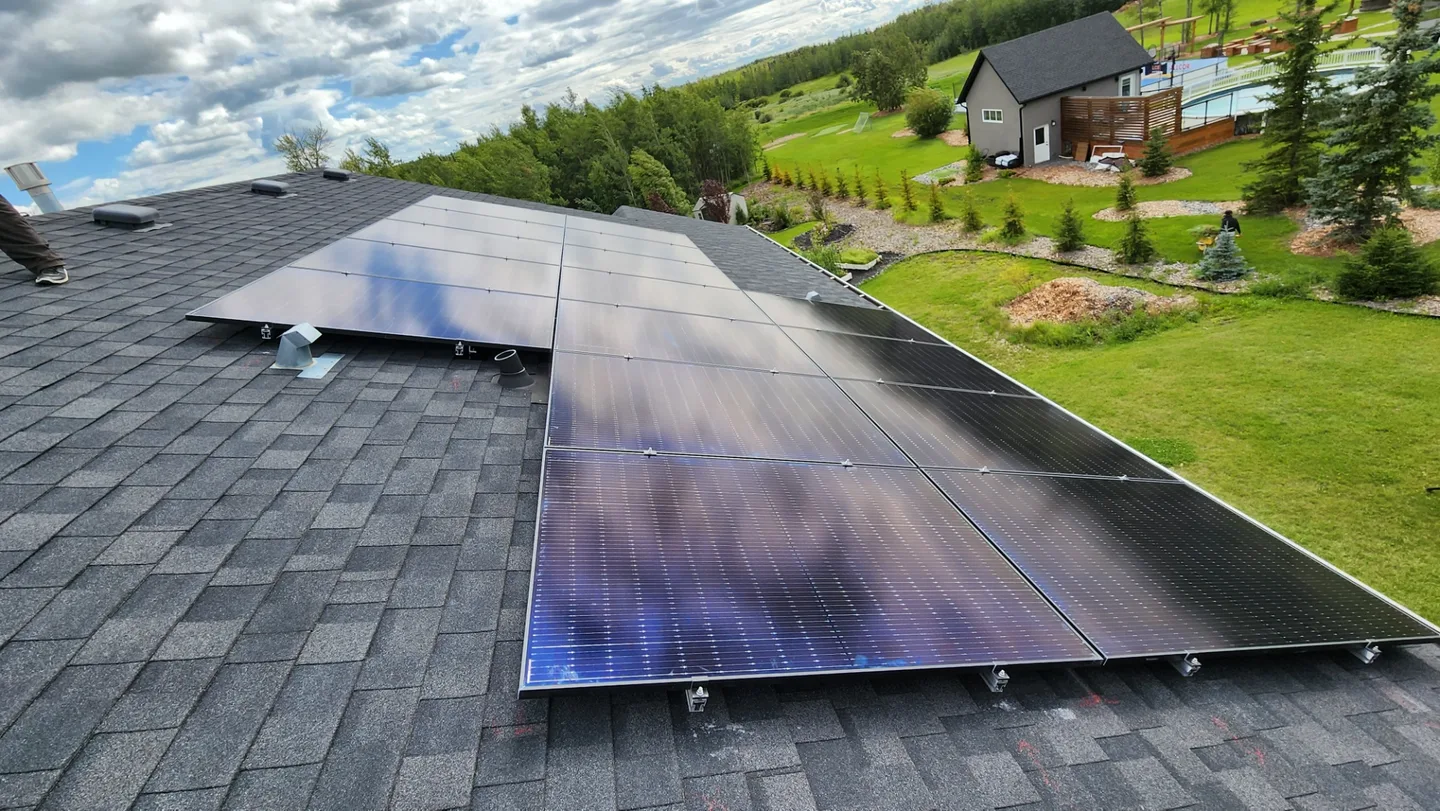
Any homeowner, skeptic, or competitor is welcome to see the workmanship firsthand. I will set up the ladder and you can check the install for yourself, or look through the full set of install photos. I welcome the criticism.
Build it yourself, watch the price move
The price follows the system, not your postal code.
Start with the correct base build. Add what you actually want. The number and the diagram update as you go. Nothing here is a package you get talked into. It is a menu you build from.
Same panels a discounter uses. Every wire routed underneath the array, sized right so nothing runs hot, a Master Electrician stamp, a 25 year warranty registered under licence #13824. This is the floor, not the upsell.
Your build, roughly
The correct base build
A typical 9.4 kW Alberta home lands at $25,850 at my $2.75 per watt anchor. My own roof is a bit bigger at 9.56 kW.
CEIP financing at 6.0% fixed can cover the whole cost, up to $50,000 residential. You pay it back on your property tax bill.
Call about your build, (780) 904-3462 Or size it yourself first →No signup. No credit pull. He only calls if you ask.
Why the number moves
It is scope, not markup.
Every step up the ladder is a bigger system doing more for you. Same standard of work at the bottom rung and the top. You are never paying more for the same thing.
The 1% build
Solar, battery, EV, and a generator that never quits.
The buyers who reach $3 a watt are not paying a premium tax. They are buying everything, all at once, as one integrated system. Here is how the same house carries itself, hour by hour, no matter what the grid does.
A large solar array covering the whole roof powers everything you are using in real time, and sends the extra into the battery instead of giving it away to the grid. Your EV charges off your own power, which means even a fuel shortage does not strand you.
A battery bank big enough to run the essentials for a day or two takes over after dark. The house runs on sun you already made and stored. Nothing switches, nothing flickers.
Whole home backup so the switchover is automatic and you never notice the grid went down. The lights stay on, the fridge keeps running, the furnace keeps the house warm. You may only find out a neighbour lost power.
At the very top, the move I have only built on the most exclusive projects: a natural gas standby generator, Cummins or Generac class, sitting behind the battery.
The array runs the house and charges the battery through the day.
Stored sun runs the house after dark. Nothing switches, nothing flickers.
Natural gas, Cummins or Generac class, running the whole house. Uninterrupted power, no matter the circumstances.
That is the 1% of solar, and yes, that is the build that lives at the top of the range.
Most people do not need all of it. You decide how far to take it, and the number follows the system you actually choose.
What the highest standard actually looks like.
Not a slogan. Four things you can verify with your own eyes, on your own roof, on the day.
Every run tucked underneath the array, nothing draped across the shingles, nothing hidden behind a conduit guard to cover up messy work. You can walk the whole perimeter and never see a wire. Most companies cannot show you that.
Licence #13824. The name on the permit is the name on the roof. No subcontractors, no handoff, no call centre. If anything is ever wrong, one accountable licensed person answers the phone.
The right wire thickness, the shut-off switch where a firefighter can reach it, every part clearly labelled to the Alberta standard. The kind of work an inspector nods at and the next electrician thanks you for. You never see it, until the day it is the reason nothing went wrong.
Every panel monitored so a single underperforming module gets caught, not ignored. Every install documented to spec. Built to sit on your roof for its full 25-year warranty and beyond, untouched.
The part most companies will not say
I turn down winter solar installs. On purpose.
A roof covered in snow and ice is not the roof I want to be fastening racking to, and it is not the roof I want your panels sitting on for the next 25 years. Penetrations sealed in the cold do not seal the same.
Takes the deposit, and fastens racking to a frozen roof.
From deep winter I book the design work, the paperwork, and the CEIP financing, then we install when the roof is right.
The correct build is the whole point of this page. Rushing it onto a frozen roof to hit a monthly number is the opposite of that. If the timing costs me a booking, that is the cost of doing it right.
And not just my roof
The same standard, on a customer's house.

“Friendly, helpful and great group of guys to work with. Communicated well and worked into our time slot. They almost seemed like family. Did a great job and gave lots of information. They went over and above to make our journey into solar a great experience. Would highly recommend their business to everyone.”
Cherry Grove, 4.5 kW, 10 x 455 W panels, installed 2026. Her roof, her words. The same standard I put on my own.
Built to be installed once, and never thought about again.
The cheapest system is the one you end up paying to fix. Build it right the first time and you stop thinking about it. The next time solar crosses your mind is the day it has already paid for itself.
Twenty-five year equipment warranty
A licensed name that is still here to honour it
A track record you can stand underneath
Where these numbers come from
The CEIP numbers on this page, the 6.0 percent rate, the $50,000 residential ceiling and the 20 year term, come off the City of Edmonton page for the program, Clean Energy Improvement Program, read 27 August 2026.
The city publishes 6.00 percent as the rate for the current tranche, and once your agreement is signed that rate is fixed for your whole term.
The $50,000 residential cap is set in Bylaw 20678. The city caps the term at the lesser of 20 years or the useful life of the upgrades, so a shorter lived upgrade gets a shorter term.
Every rate here is a published third party figure or is labelled as my own. If one has moved since the read date, tell me and I will correct the page.