Commercial LED retrofit, Edmonton and central Alberta
LED lighting retrofits for Edmonton buildings, permit pulled and inspected.
Most lighting retrofits around here are sold by people who have never pulled a permit. Mine are not.
I am an electrician who does lighting, not a lighting salesman who found an electrician. Dmitry Naboka, Master Electrician #13824, 14 years in the trade.
Rather not call? Leave your number.
I call back from (780) 904-3462 the same day, or first thing next morning. No pitch.
Got it. Dmitry will call from (780) 904-3462 the same day, or first thing next morning.
Master Electrician #13824. Reply STOP to opt out anytime.
Every one of these jobs starts the same way. Somebody counts what is actually up there.
Free, usually 30 to 45 minutes on site, and you get the fixture count, the options and the assumptions in writing. A Master Electrician does the walkdown, not a sales rep, and nothing gets signed that day.
Or go straight at me. Call (780) 904-3462Text me instead
What it costs
- Tube on the existing ballast$105 to $135Type A. Fastest and least disruption, but it saves the least.
- Tube, ballast removed$179 to $215Type B. Nothing left in there to fail.
- New fixture, one for one$241 to $275Whole fixture out, new LED panel in. Best light quality and the biggest cut in draw.
Installed price a fixture, on a four lamp troffer. Bands, not quotes.
See every priceFour kinds of lighting live in one building. Tap what you have.
Tap a part of the building. I will tell you what that job actually involves, then take you to the part of this page that goes deep on it.
Troffers and flat panels
The flat panel in an office ceiling looks like the easy half. Six things are going on inside that fixture and only one of them shows up on your power bill. The other five are why a cheap one gets replaced twice.
See the six things inside a fixtureHigh bay and shop lighting
A tube throws light in a circle. Your shop floor is a rectangle. High bay is a different job from an office ceiling, and cold performance matters here, which is the part nobody mentions in Edmonton.
Put your own building inOutdoor lighting
Parking lot poles, wall packs and canopies are their own job. Different mounting, different aiming, and a lot more weather than anything you hang indoors.
See all four kinds of lighting workSensors and controls
Occupancy and daylight sensors are where a lot of the real savings sit, because a fixture that is off draws nothing. Fewer fixtures is not automatically less power. Controls usually are.
See the four ways to do the same jobThe electrical room, and the 347 volt trap
If your building runs 347 volt, the cheap tube swap stops being cheap. Field modifying a certified fixture voids its certification, and that is a published rule, not my opinion. Your old ballasts may also be hazardous waste, and legally they are yours.
Read the 347 volt trapPermit and levy
The permit and the levy are two different published costs, and both go on your quote instead of showing up later. We do not count a rebate without written approval. Any funding assumptions belong in your written scope.
See the permit and the levyTap a numbered pin, or use the arrow keys.
Daylight panels and colour selectable retrofits
In Edmonton your lights are the only daylight you get for most of the workday.
On December 21 this city gets 7 hours and 28 minutes of daylight, and the sun is down by 4:13 pm in mid December.
- If your building runs a normal day, the back half of it happens under whatever is screwed to your ceiling.
- That is worth doing properly, and it is worth doing at a wattage that does not punish you every month.
How much daylight Edmonton actually hands you
Real sun up hours, not a feeling about winter.
Sun up hours and the 4:13 pm earliest sunset for Edmonton from timeanddate.
One room, one afternoon, Edmonton
Drag it across. Same office, same window, same desk.
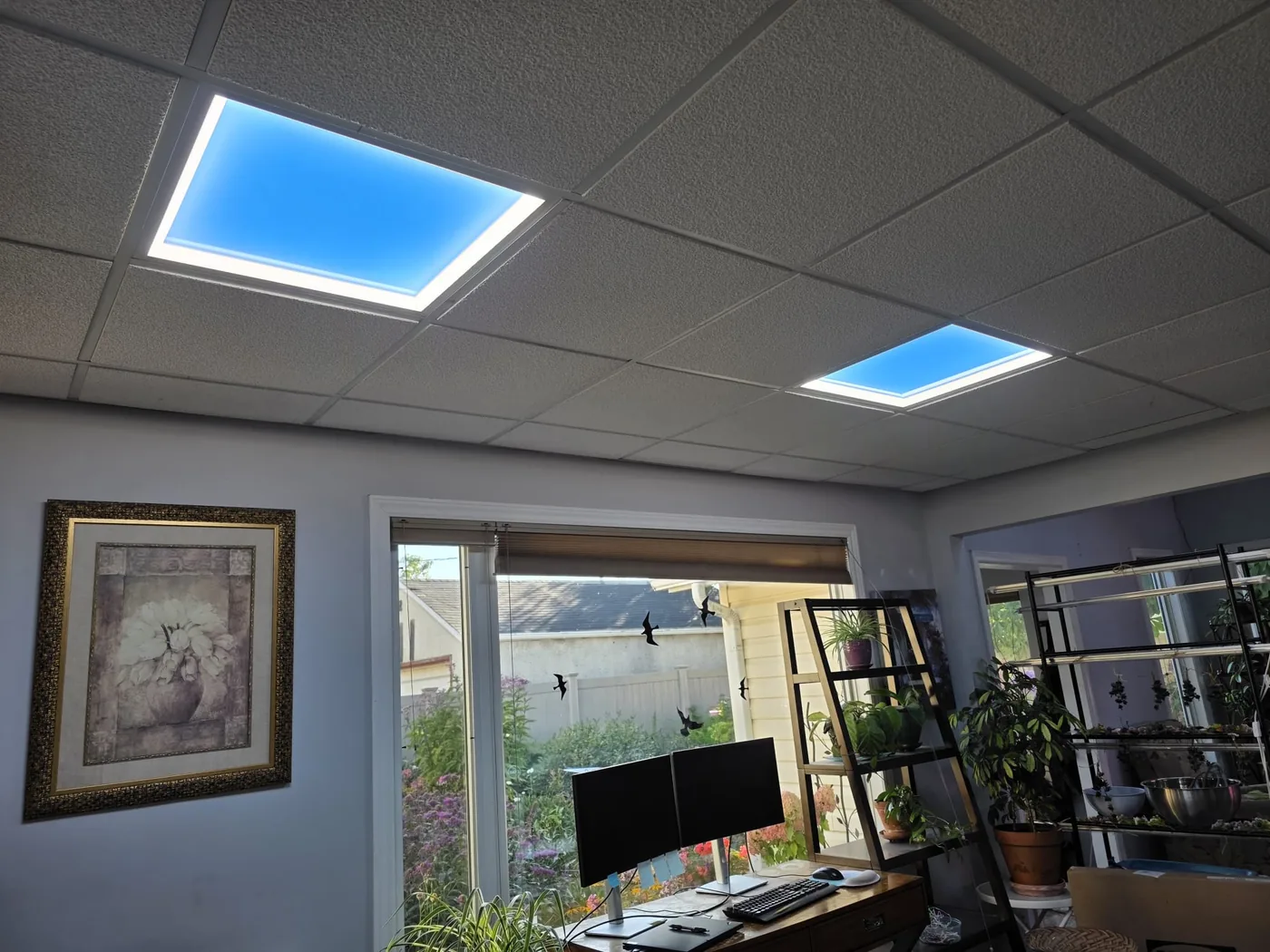
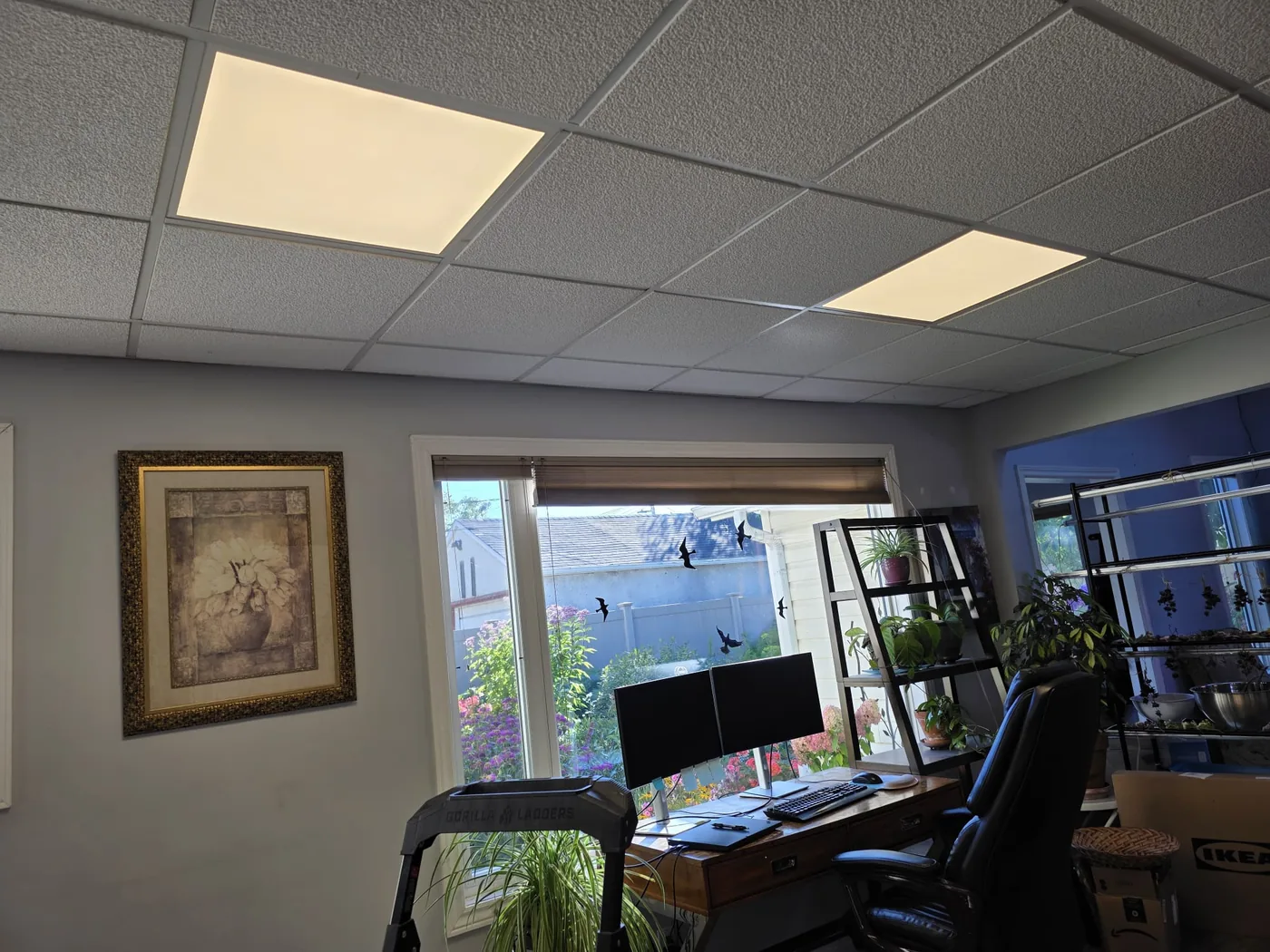
Two flat panels came out, two skylight panels went into the same grid openings. The ceiling was never opened up. This is my own customer's house in Edmonton, not a showroom.
Which one are you
The answer changes the whole pitch. Pick your ceiling.
This one is a money job
This is the case where the arithmetic does the selling. A four lamp 32 W T8 troffer draws roughly 143 W once you count what the ballast burns. A 2x4 LED panel at a mid setting draws about 40 W for a comparable lumen package. Same ceiling, same opening.
Now the part most quotes skip. If you want the skylight look in the same ceiling, the arithmetic changes, because a skylight panel is lighting a diffuser and a sky image as well as the room, so it draws more than a plain panel of the same size.
So off a three lamp fluorescent the skylight panel still cuts about a third. Off a two lamp fluorescent it is a wash, and you are buying the room, not the bill. Same word on the old fixture, two completely different answers, and the only thing that separates them is how many lamps are in there.
Which is why on most buildings I end up doing both. Skylight panels where people sit and look up. Plain panels where the room just needs light, because that is where the 143 W to 40 W drop lives. You get the look in the rooms that matter and the savings across the rest of the floor.
Illustrative arithmetic on 32 W T8 lamps with 12 percent ballast loss, not your quote. Your actual result depends on the lamps in there now, the condition of the ballasts, your run hours and your real electricity rate. Put those in the calculator on this page and it works it out in front of you.
Do not let anyone sell you a payback
If your panels are already LED, the efficiency job is mostly done and the easy savings are already banked. Swapping one LED panel for another LED panel can come out flat, and a skylight effect panel can even draw more than the plain panel it replaces, because it is lighting a diffuser and a sky image, not just throwing lumens down.
So I will not pretend this one pays for itself. You would be buying the look of the room, better colour rendering, and controls. Those are real reasons. A fake payback is not. If anyone quotes you a savings percentage on an LED to LED swap, ask them what the old fixture draws, and watch what happens.
Where this does still make money on an LED building: controls. Occupancy sensing and daylight harvesting in rooms that sit lit and empty. That is worth looking at on the walkdown.
This is what they were built for
Basements, interior boardrooms, back offices, treatment rooms, anything in the middle of a floor plate. There is no window to add and cutting one in is a roofing and framing project with a permit attached.
A skylight effect panel gives that room something to look at instead of a flat lit rectangle, using the grid opening that is already there. No drywall, no framing, no roof penetration, and the fixture is hardwired the same way the old one was. In a windowless room this is the single cheapest thing you can do that actually changes how the space feels.
Ceiling type matters here. A T-bar grid takes these directly. A hard ceiling needs a surface frame or a recessed kit, and that is a real line on the quote, so I check it on the walkdown rather than finding out on install day.
It reads as an opening, not a fixture
A skylight panel drops into the same 2x2 grid opening the old fixture came out of. No drywall, no framing, no roof penetration. In a basement or an interior office with no window at all, that is the difference between a room you tolerate and a room you use.
Colour selectable, chosen once
Colour selectable fixtures carry several white tones in one housing, so the tone gets matched to the room on install day instead of ordering the wrong one twice. Be clear on what this is: on most of these it is a setting made at install, not a dial you turn through the day.
If you want tone that moves through the day, that is a different fixture and a different wiring plan, and I will tell you so before you buy.
The wattage question, answered honestly
A retrofit only saves money if the thing coming down draws more than the thing going up, and with these the lamp count decides it, not the word fluorescent.
- A three lamp fluorescent 2x2 down to one skylight panel is a real cut.
- A two lamp 2x2 is close to a wash.
- Coming off a panel that is already LED it can go up.
- I count the lamps and read the ballast before I tell you which one you are in, because all three happen in the same building.
No lamps, no ballasts, no ladder every spring
The reason people hate fluorescent is not the light, it is the upkeep.
- Tubes that pink out, ballasts that buzz, and somebody on a ladder in an occupied office.
- LED panels are one sealed assembly with no lamp to change.
- Rated life on these runs to tens of thousands of hours. It is not maintenance free, and the warranty is the number that matters, so I quote you the actual warranty term in writing rather than a lifespan.
What I will not tell you about these
Lighting gets sold on some big promises. Here is where I stop, and why.
That it treats winter depression
Light therapy for seasonal depression is a real treatment, and the protocol is roughly 10,000 lux measured at your eye, 16 to 24 inches from your face, for 20 to 30 minutes (Mayo Clinic).
- A ceiling panel is metres away and spread across a whole room, so a few hundred lux at the desk is the realistic order of magnitude.
- That is good lighting. It is not a light box, and nobody selling you a ceiling should say otherwise.
- If that is what you are after, talk to your doctor about a light box.
That it will make your staff more productive
There is research on cooler, brighter light and alertness at work, and the honest summary of it is that the reviewers themselves rated the evidence very low quality (Cochrane review).
- Most people do prefer a brighter, cleaner lit room, and that is a fine reason to do this.
- A productivity number is not something I am going to invent for you.
A savings percentage, before I have seen your building
Everyone quotes a percentage off the ceiling.
- The number depends on what is up there now, how many lamps are in it, whether the ballasts are still drawing, your hours, and your actual rate.
- Give me those and the calculator on this page will do it in front of you with your numbers in the boxes.
- A number I made up before the walkdown is worth nothing to either of us.
What I will tell you
I am an electrician who does lighting, so I will measure the voltage at a fixture, count what is actually installed, check whether the ceiling can take the fixture you want, and put the wattage and the warranty in writing. Dmitry Naboka, Master Electrician #13824, 14 years in the trade.
Colour selectable panels and skylight effect panels are stocked product, not a special order. The right one depends on ceiling type, mounting depth, voltage and what the room is for. That is a ten minute conversation, not a catalogue.
Real jobs, shot on the day
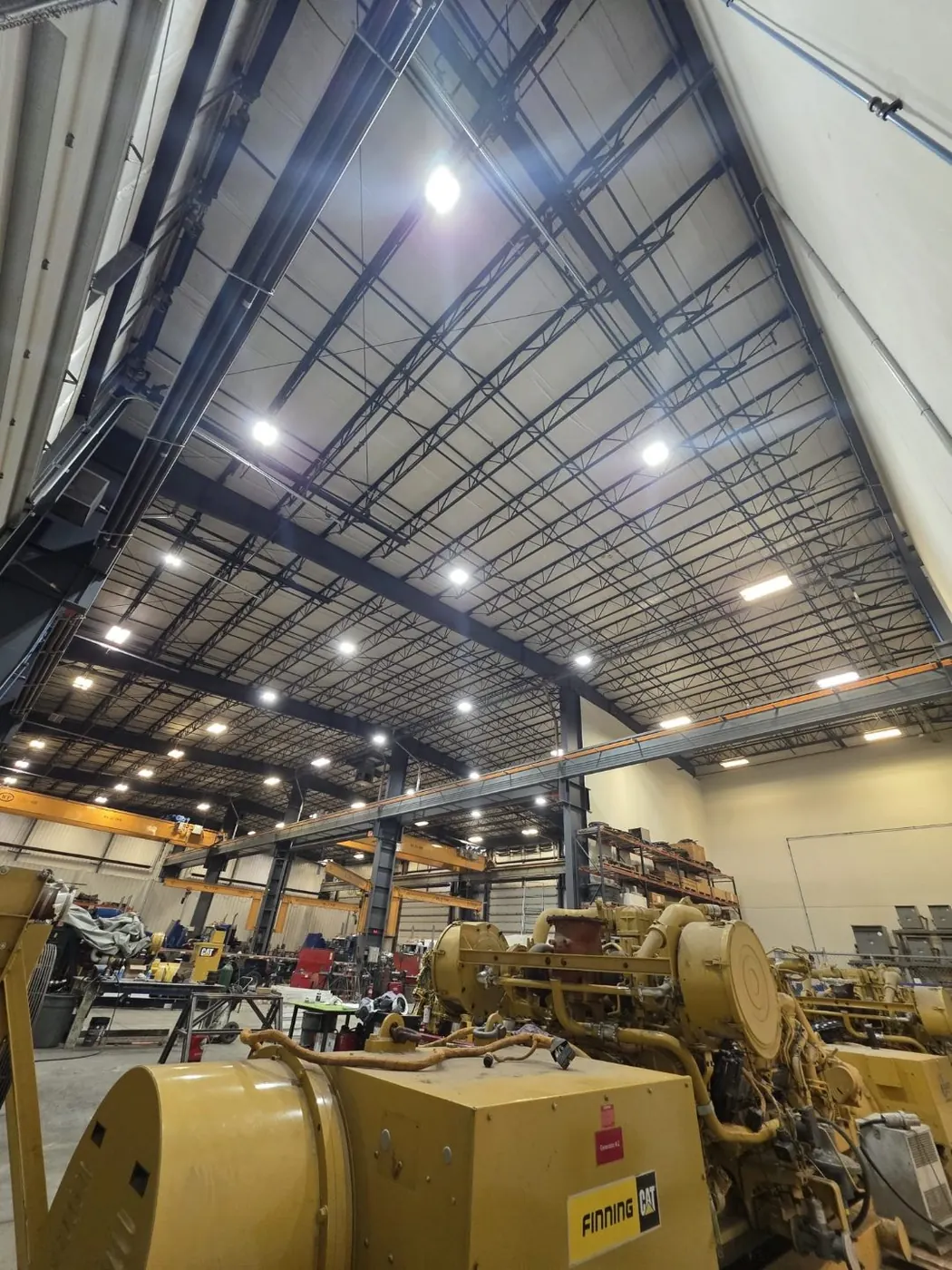
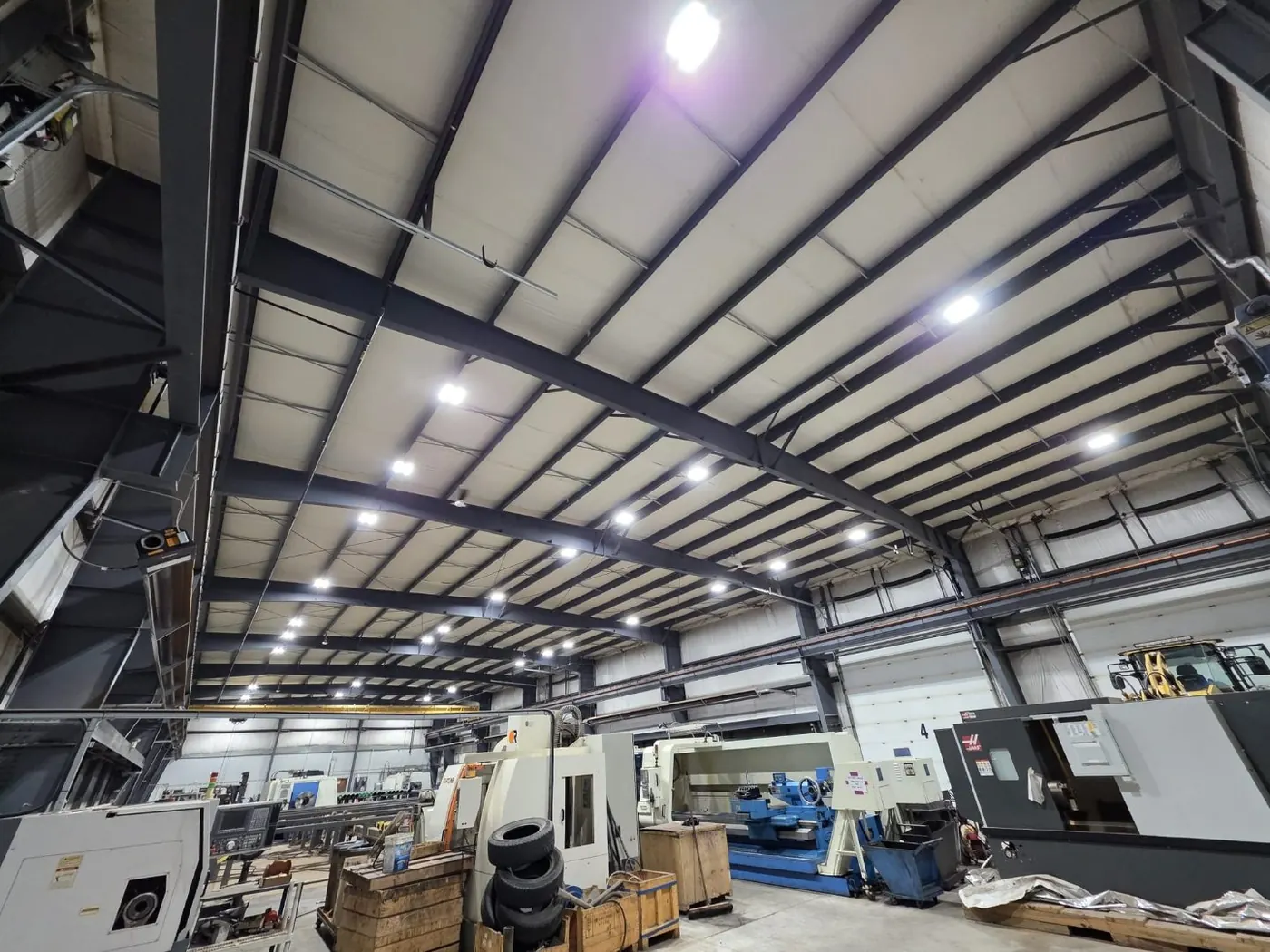

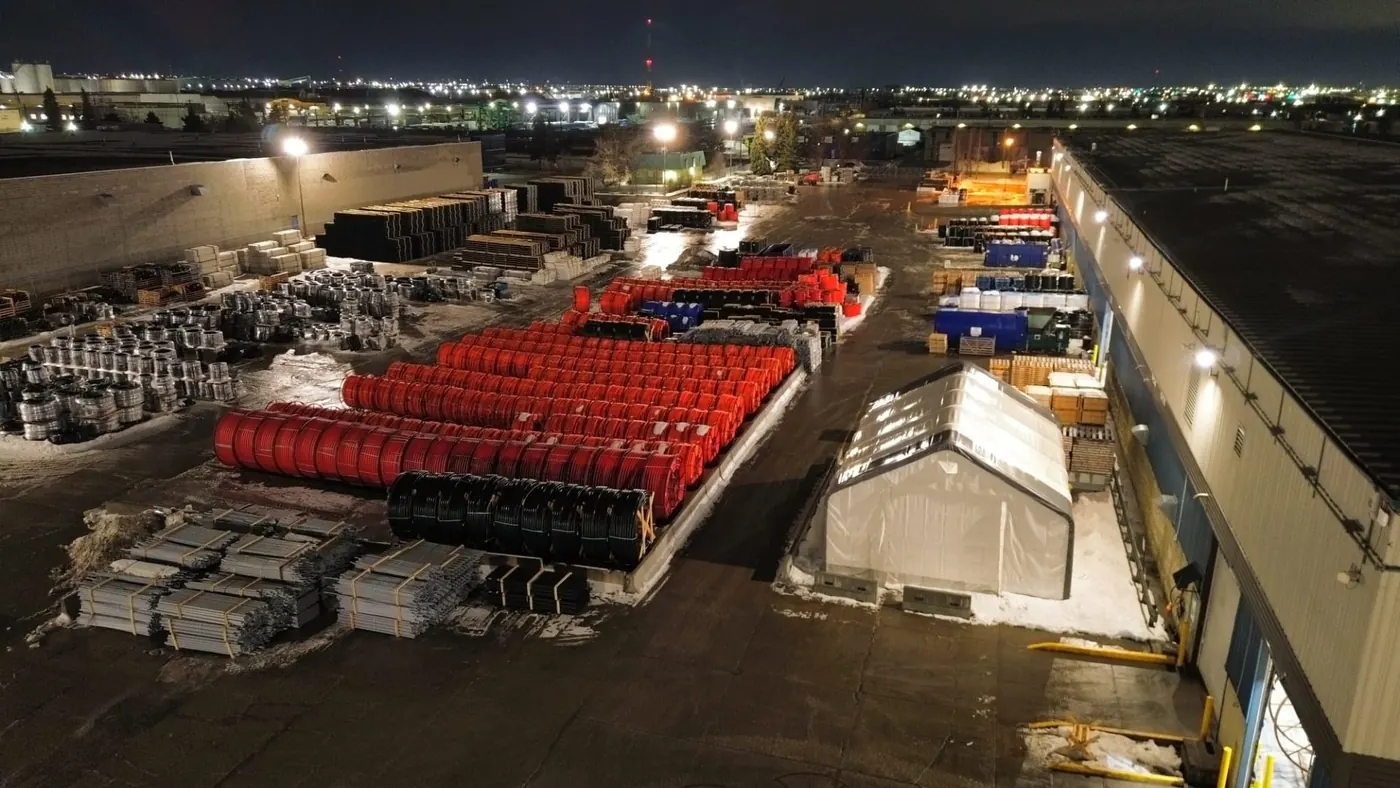
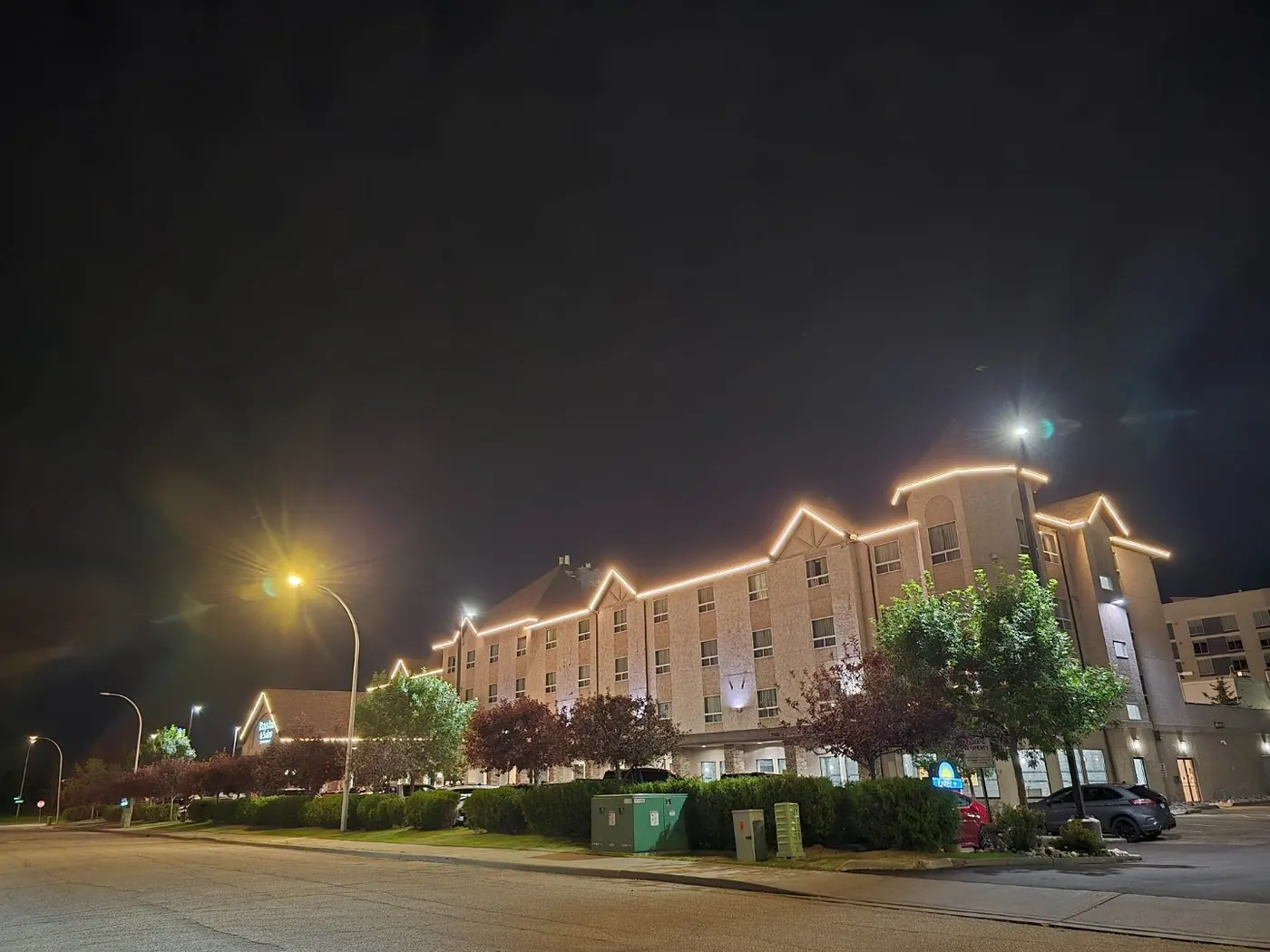
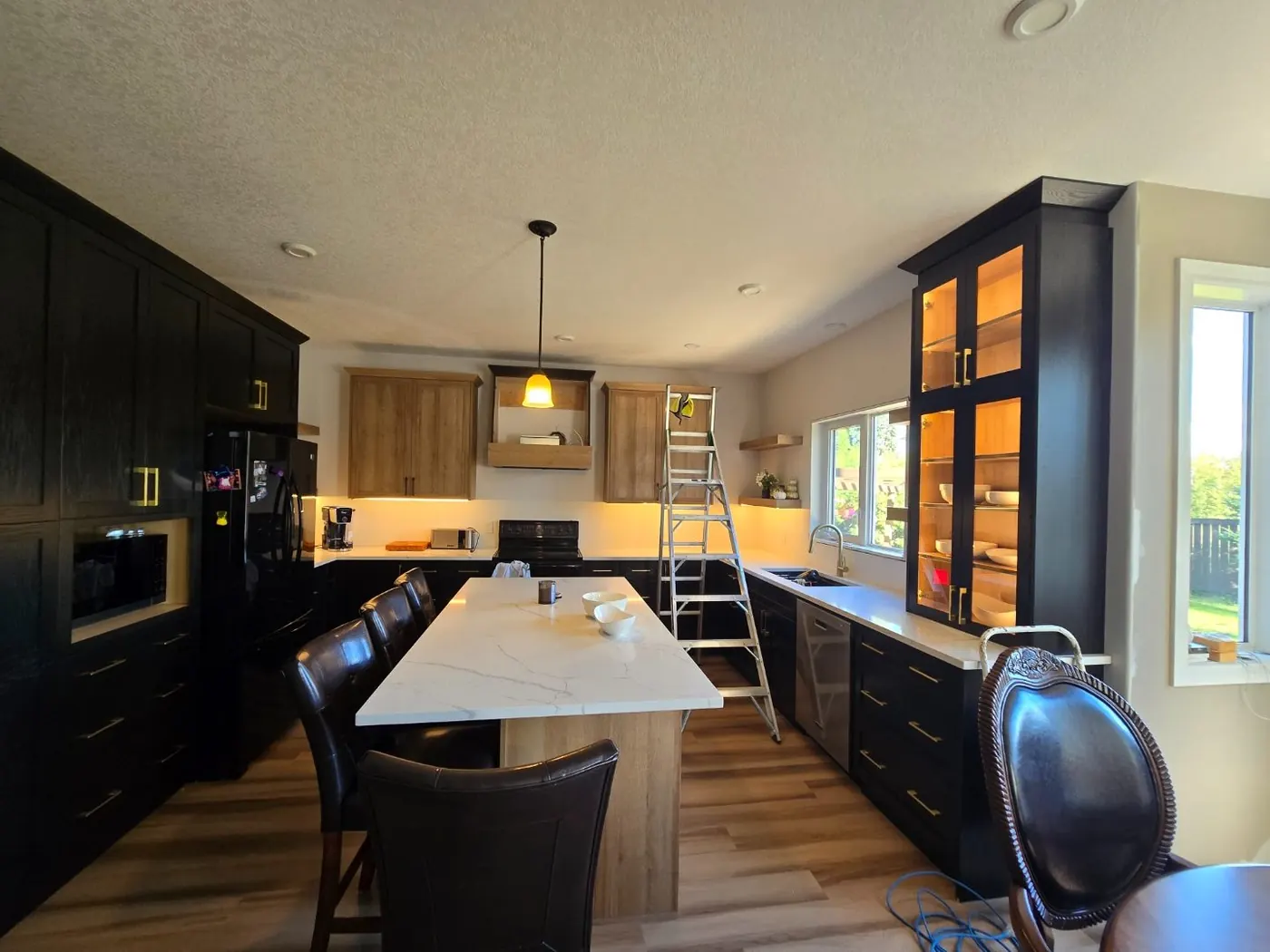
Swipe. Seven jobs, all Alberta, all my crew.
That means all four of these, on every job.
I meter first
I meter your fixtures before I quote them
I pull the permit
I pull the permit
I price the label
I price the certification label
I say so
and I tell you when the cheap version is the wrong version
Start here
Tell me what kind of building it is and I will show you the version that applies to you
Everything below is on this one page. These jump you straight to the part written for your building, with the fixture counts and the price bands for that kind of job.
Any commercial building, the whole offer
Offices, libraries, municipal buildings, shops and warehouses. The walkdown, the three ways to do it, planning ranges, and the calculator in one place.
Warehouse or high bay
Ceilings over 20 feet, racking aisles, and the 347 volt question that decides your whole budget.
Shop or manufacturing
A 104 fixture Edmonton shop goes 20.0 kW to 5.2 kW. Example building, both options priced at my numbers.
Showroom or dealership
Where colour rendering actually costs you a sale. An example showroom, 94 fixtures.
Office or tenant space
Troffers and flat panels, glare and flicker, and doing it in zones so nobody loses a workday.
Parking lot or outdoor
Poles, wall packs and canopies. Full cutoff optics cost more and three of my markets require them.
Not sure yet, run the numbers
Put your fixture count and your power rate in and see the band, right here on this page.
Or read it straight through
- The four kinds of lighting work, and why they price differently
- The four ways to do this job, and what each one costs
- The six things inside the fixture, and the one everybody quotes
- Six things that cost real money and are missing from most quotes
- Example buildings, real fixture counts, real prices
- Price bands, and the permit fees published by the city
- The six steps, so you know what day you are on
- The eight questions I get on every walkdown
- The long version, with all the tables
Options, With The Reason For Each
Three ways to do a lighting retrofit
A lighting quote that shows you one price for one product is hiding the interesting part. There are three honest paths and they do not cost the same or save the same.
Option 1
Tube conversion, ballast bypass
Best when the fixtures and the lenses are still in good shape and you want the fastest payback per dollar spent.
We keep the housing, take the ballast out and wire the sockets direct. Fewer parts, faster per fixture, lowest material cost of the three.
A yellowed lens still throws yellow light. You keep the old fixture and whatever condition it is in.
Option 2
New fixture, panel or troffer
Best when the lenses are yellowed, the grid is tired, or the space needs more light than it has now.
A flat panel usually cuts well over twice the load a tube conversion cuts, so across a full building the payback often lands in the same window as the cheaper path. You also get a new lens, a new driver and a warranty on the whole fixture instead of just on the lamp.
More money per fixture up front, and a hard ceiling needs a surface frame or a recessed kit that a tube swap does not.
Option 3
Split it by area
Best when the building has offices, a shop and a yard that do not all need the same thing.
We walk each area and price it on its own. The front office can get new panels while the warehouse gets tube conversions, and you are not paying premium product where nobody is reading.
Two paths on one job means two material lists and a longer lead time on ordering.
If this job is going through CEIP, read this before you order anything. CEIP does not finance LED lamps or tubes of any kind, which makes the new fixture path the only financeable path on a CEIP job. That is in writing in the CEIP commercial eligible upgrades list.
The calculator
Put your own building in and see the range
It uses published wattage tables for what is up there now and real prices off jobs I have already invoiced. It gives you a range instead of one number, because until I meter a fixture I do not know where inside the wattage band yours sits.
Want it on its own page to send to your partner or your accountant? Run the calculator. Every result has a shareable link.
What I actually do
Four kinds of lighting work, and they are not the same job
Indoor troffers and flat panels
Offices, hallways, retail, showrooms. 2x4 and 2x2 grid fixtures. This is where the tube versus ballast versus new fixture decision lives, and where the 347 V question decides it.
High bay and shop lighting
Warehouses, fabrication shops, machine shops, garages. Linear high bay in the 165 W class. Needs 18 to 20 ft of open ceiling to lay out on a wider spacing, and I check that with a tape before I price it.
Warehouse lighting mounting height guidanceOutdoor, poles, wall packs and canopies
Parking lots, yards, loading docks, signage. HID to LED. Pole work is bonding work, CEC Rule 30-1024(1), and three of the municipalities I work in mandate full cutoff optics that cost more.
Guide to the CE Code Section 30Strathcona County Land Use Bylaw s.3.10Controls and sensors
Occupancy sensors in low traffic aisles, daylight harvesting near skylights, zone switching. Field measured savings run up to 76 percent in a parkade and about 37 percent on a retail lot, and those apply to the load that is left after the retrofit, never on top of it.
PNNL-21923 lighting control field studyThe reason I split these out is that most quotes do not. A single line that says "supply and install LED lighting" is how a shop ends up with high bays hung at 14 ft and dark aisles between them.
Dmitry Naboka, Master Electrician #13824, 14 years in the tradeThe conversion paths
Four ways to do the same job. The cheapest one is not the one I recommend, and here is why in a table.
| Path | What happens | A fixture | What fails next |
|---|---|---|---|
| Type A Tube on the existing ballast | New LED tube, old ballast stays and keeps drawing. Fastest, least disruption. | $105 to $135 | The ballast. It is the part that was already going to fail and you paid to keep it. Saves the least. |
| Type B Tube, ballast removed | Ballast comes out, sockets rewired, fixture relabelled per CSA C22.2 No. 250.1. | $179 to $215 | Nothing left in there to fail. Restricted at 347 V by STANDATA 24-ECB-030. Usually the right answer on 120 V and 277 V. |
| Type C Tube on an external driver | Remote driver feeding the lamps. Rare on a retrofit here because it is the most labour for the least gain over Type B. | Quoted per job | The driver, and it is now a part nobody stocks. I rarely recommend it. |
| New fixture One for one | Whole fixture out, new LED panel in. Best light quality and the biggest cut in draw. | $241 to $275 | Nothing for the warranty term. Costs the most and the old fixtures go in the bin. What I recommend on 347 V. |
I put all four on one page, $11,443 to $26,242, with the load and the payback beside each. The middle option is usually the right answer. Showing all four is not indecision, it is the only way you can tell whether the cheap number is actually cheap.
Read the whole quote, four options with the load beside each
Dmitry Naboka, Master Electrician #13824, 14 years in the tradeWhat LED actually changes
Six things going on inside that fixture, and only one of them is on your bill
Where the watts go now
- 4 tubesabout 4 x 24 W
- Ballast loss and heatthe rest of the 110 to 132 W
- Light that dies inside the fixturea tube throws 360 degrees
Where they go after
- LED boards50 to 60 W a fixture
- No ballaston the Type B and new fixture paths
- Light aimed downfewer watts, more light on the floor
A tube throws light in a circle. Your floor is not a circle.
A tube emits all the way around. An LED points down. Same idea, drawn:
That is why a lower wattage fixture can put more usable light on the ground, and why comparing tube lumens to tube lumens is the wrong comparison. Delivered light is what matters.
A ballast is a part with a life span, and it is short
It regulates current to the lamps. It runs warm, it hums as it ages, and it is the component that takes your fixture out of service. Call it 60,000 hours. On a shop running 3,650 hours a year, that is a maintenance call you are scheduling whether you plan it or not.
USDA Forest Service fluorescent retrofit studyFluorescent does not fail, it fades, and you never notice
Output drops slowly over years so your eyes track it down with the room. LED is rated L70, which means 70 percent of the original output at the rated hour count, typically 50,000 hours. That is a published curve instead of a slow surprise.
Cold is the one nobody mentions in Edmonton
Open fluorescent fixtures lose a large share of their output at low temperature. Loading docks, unheated shops, cold storage, parkades. LED does not do that, it actually runs slightly more efficiently cold. If your dock is dim in January, that is not the tubes wearing out.
Lighting Research Center 2x4 thermal studyFlicker, hum, and instant on
The reason a retrofitted shop feels different rather than just cheaper. No warm up, no strobing under a spinning chuck, no buzz over a quiet office. This one does not show up on the power bill and it is the thing your people comment on.
Colour temperature and CRI, pick it once and pick it right
Pick the colour once and pick it right. This is the strip, warm on the left, cool on the right.
5000 K where you want contrast and alertness. 4000 K anywhere people sit and work.
Showrooms are a different spec sheet
A showroom or dealership wants high CRI so the paint reads true, which is a colour rendering spec, not a colour temperature one. For contrast, HPS sits around CRI 20 to 24. That is why everything in an HPS lot looks orange.
Controls are the seventh thing, and they are where the extra savings hide. Sensor compatibility depends on which tube you install, so I check it against the product data before I order.LEDVANCE SubstiTUBE sensor compatibilityPNNL-21923 lighting control field study
What the low bid leaves out
Six things that are true, cost real money, and are missing from almost every lighting quote in this city
This is the section that costs me jobs and wins me customers. I would rather you read it here than find out about it after somebody else has already invoiced you.
Confirm funding before counting it
Energy Efficiency Alberta, wound up 2020
ERA Energy Savings for Business, closed and fully allocated
SEMI, industrial only
The write off is real, though
Commercial lighting normally lands in capital cost allowance Class 8 at 20 percent declining balance, and Class 8 qualifies for the accelerated first year allowance through 2027. Talk to your accountant about that, not to me. I am an electrician.
CRA capital cost allowance classesThe 347 volt trap, and why the cheap swap stops being cheap
Alberta STANDATA 24-ECB-030 says a luminaire with double ended lamps on a ballast rated over 150 volts to ground, disconnected and reconnected, counts as a new luminaire and needs disconnecting means.
It extends that to energy conservation retrofits. Most Alberta warehouses and commercial buildings are 347 volt. So the cheap ballast bypass lands inside that sentence. A new fixture with no double ended lamps does not.
Alberta STANDATA 24-ECB-030Field modifying a certified fixture voids its certification
Field modifying a certified luminaire voids its certification. This is the line between the two.
Per CSA C22.2 No. 250.1, with the kit certified for the fixture per STANDATA 24-ECB-002. Most low bids do not price the label.
Your old ballasts might be hazardous waste and they are legally yours
Magnetic ballasts made before 1980 are PCB waste, Class 9 UN2315, and the building owner is legally responsible for them. I count them, photograph the labels, manifest them, and route them through Aevitas in Edmonton under EPEA approval 134-05-00.
The Certificate of Recycling goes in your turnover package. Tubes are mercury, and the commercial Eco Station fee is $1.00 a tube. The Eco Station will not take PCB ballasts from a business at all.
Environment and Climate Change Canada, PCB rules for electrical contractorsAlberta PCB checklistAevitas Edmonton, EPEA approval 134-05-00Edmonton Eco Station accepted items and feesFewer fixtures is not automatically less power
Here is the arithmetic nobody publishes.
What happens under 18 ft
Bright pools under each fixture and dark aisles between them. If your building does not fit, I will tell you in writing before I sell you anything.
Proof
Example buildings, real fixture counts, real prices, real towns
Two example buildings, drawn at the fixture count I quote
104 fixtures, an example Edmonton shop
94 fixtures, an example dealership showroom
Every square is one fixture. Example buildings at the counts and prices I actually quote, not round numbers.
Old fixtures out, flat LED panels in, same ceiling
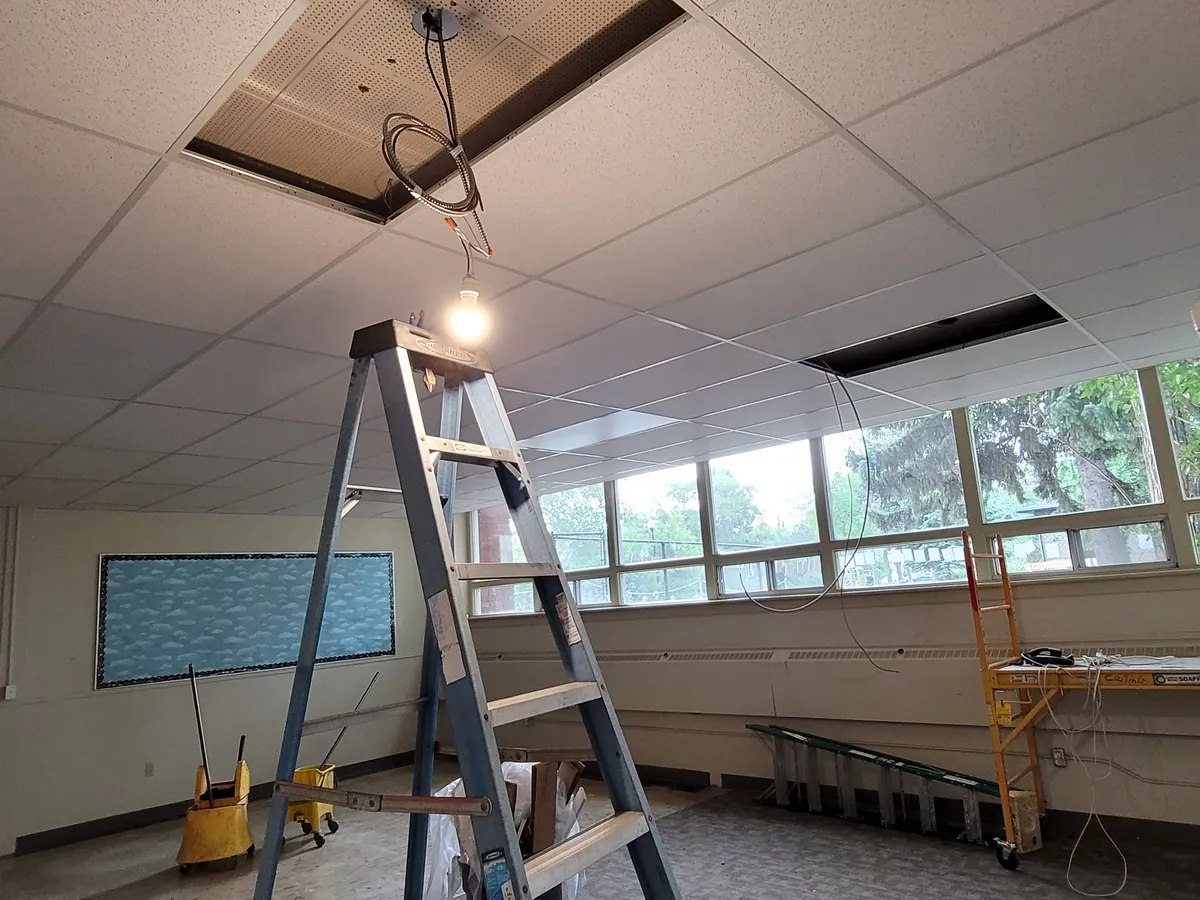
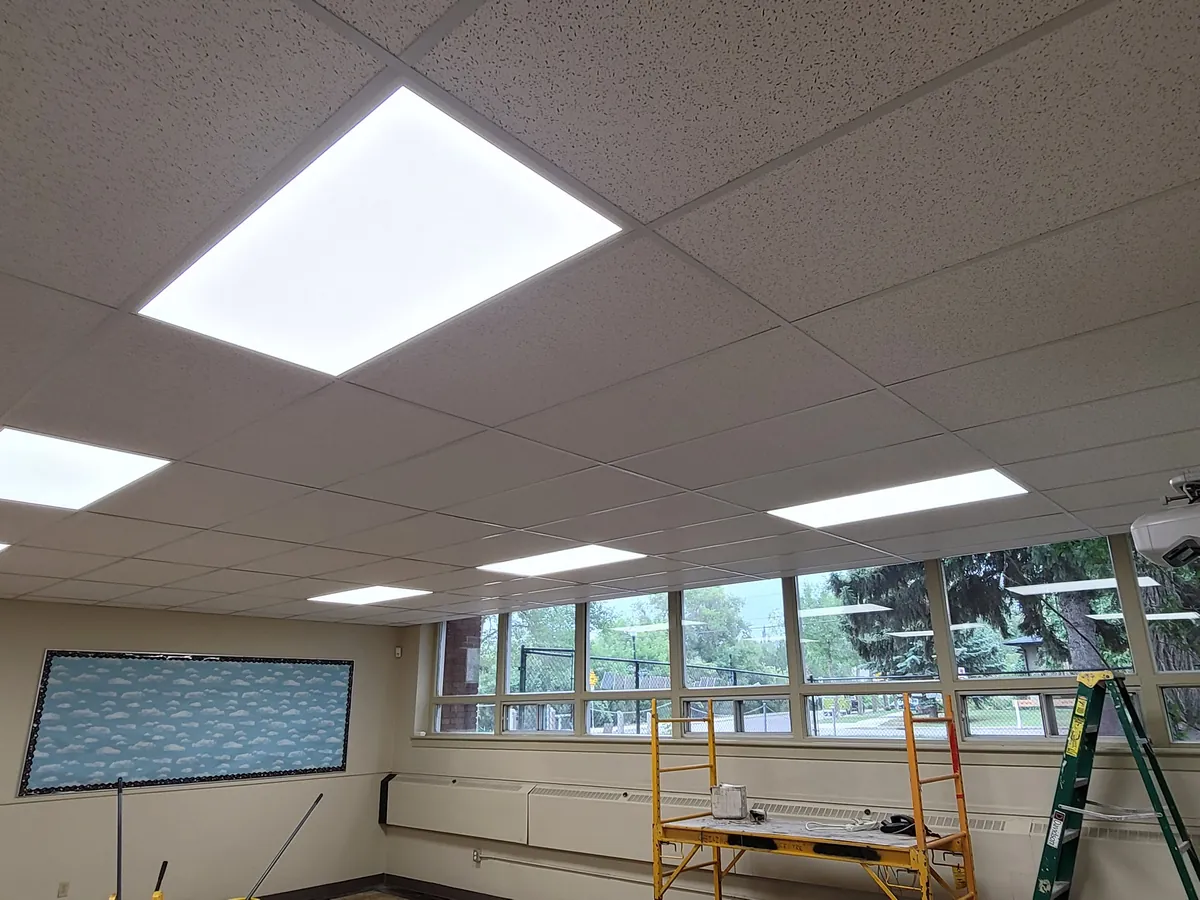
I meter the light level before I touch anything, on every single job. That before number is the whole proof and it is the one thing a lighting salesman cannot produce after the fact.
Work I have already done
Dmitry Naboka, Master Electrician #13824, 14 years in the trade. Co owner Kyle V., Journeyman. Five person crew, no subcontractors. Raydn Renewables has been trading since August 2025.
Who is actually on your roof and in your ceilingWhat it costs
Price bands, then a site visit. Not a number pulled out of the air.
Every band low is set so the job is still worth doing properly. That is not me being greedy, it is me not underbidding your job and then finding the money back in change orders.
Payback depends on your existing lights and run hours. Use the calculator for your building. Its estimate includes electricity savings only.
| Path | A fixture | 104 fixtures |
|---|---|---|
| LED tube on the existing ballast | $105 to $135 | $10,920 to $14,040 |
| LED tube, ballast removed | $179 to $215 | $18,616 to $22,360 |
| New LED fixture, one for one | $241 to $275 | $25,064 to $28,600 |
| Fewer high bay fixtures, over 18 ft | $490 to $540 | $19,600 to $21,600 on 40 fixtures |
The permit and the levy are separate, and they are published
A stand alone electrical permit in Edmonton is $160 on work up to $3,000, $230 from $3,001 to $10,000, and $405 from $10,001 to $50,000, plus a 4 percent Safety Codes Levy, on the schedule effective January 1, 2026. I put the real fee on the quote instead of a padded allowance.
City of Edmonton commercial electrical permitsEdmonton 2026 Planning and Development Fee Schedules, Appendix DFull cutoff optics cost more, and three of my markets require them
Strathcona County and St. Albert require full cutoff. Parkland County requires Dark Sky compliant product on anything that needs a permit. Spruce Grove can ask for a photometric plan. Edmonton requires none of it. I read your bylaw before I price the fixture, not after.
Strathcona County Land Use Bylaw s.3.10St. Albert Land Use Bylaw 18/2024 s.3.24Parkland County Land Use Bylaw, consolidatedSpruce Grove Land Use Bylaw C-824-12 Part 6 s.37Edmonton Zoning Bylaw 20001 s.5.120347 V capable exterior product costs more
And most Alberta commercial exterior is 347 V. If a quote does not name the voltage, it has not priced the right fixture yet.
Outdoor jobs do not get a price on a web page from me
Pole condition, buried feeder condition, lift access and the photometric layout change the number too much. What I will publish is the energy and the maintenance you stop paying. The install number comes off a site visit.
Planning bands, not a quote. The walkdown turns them into a number.
Free, usually 30 to 45 minutes on site, and you get the fixture count, the options and the assumptions in writing. A Master Electrician does the walkdown, not a sales rep, and nothing gets signed that day.
Or go straight at me. Call (780) 904-3462Text me instead
How the job runs
Six steps, and you know what day you are on
The walkdown, free
I count fixtures, meter a sample fixture, read the nameplate on the ballast, take a lux reading, check the ceiling height with a tape, confirm the supply voltage, and photograph any pre 1980 ballast labels. Usually an hour on a 100 fixture building.
The written scope, with all the options priced
Every path you qualify for, priced side by side, with the load and the payback on each. Not one number and a signature line.
Permit
Pulled under my Master Electrician number, #13824. Fee shown at cost with the levy separate.
City of Edmonton commercial electrical permitsInstall, zone by zone
A 100 fixture indoor retrofit is normally two to four days with the five person crew, worked around your operation. Old tubes boxed as we go, ballast labels photographed and counted.
Disposal, manifested
Tubes to the Eco Station on the commercial fee schedule. Any PCB ballast manifested as Class 9 UN2315 and routed through Aevitas in Edmonton, EPEA approval 134-05-00.
Aevitas Edmonton, EPEA approval 134-05-00Environment and Climate Change Canada, PCB rules for electrical contractorsTurnover and inspection
Inspection closed out, then a package: fixture schedule with counts and wattages, the after lux readings beside the before, warranty terms, the certification labels used, and the Certificate of Recycling. On paper, so it survives the next building manager.
Straight answers
The eight questions I get on every single walkdown
What does a commercial LED retrofit cost in Edmonton?
On a four lamp fluorescent troffer, how far you go sets the price, and high bays are their own tier.
To put an LED tube on the existing ballast
roughly $105 to $135 a fixture installed
To remove the ballast
$179 to $215
For a whole new fixture
$241 to $275
High bays
run $490 to $540
Those are bands, not quotes, and every one of them is priced to cover the work properly so I am not underbidding the job and then chasing extras. The band becomes a number after I walk the building.
Is there an LED rebate or grant in Alberta?
We do not deduct a rebate from your estimate without written approval. Eligibility depends on the current program, property and equipment. We check those separately before you commit. Ask your accountant about tax treatment.
Do I need an electrical permit to convert fluorescent or HID to LED?
Needs a permit
Yes
Changing the fixture or the way it is wired is an improvement to the installation, not maintenance.
Does not
No
Swapping a lamp for the same lamp is maintenance.
In Edmonton a stand alone electrical permit is, on the 2026 schedule:
Up to $3,000 of work
$160
And from $10,001 to $50,000
$405
Plus a Safety Codes Levy
of 4 percent
My shop is 347 V. Can you still do a tube retrofit?
Carefully, and sometimes not at all. Alberta STANDATA 24-ECB-030 treats a double ended lamp luminaire on a ballast over 150 V to ground that gets disconnected and reconnected as a new luminaire needing disconnecting means, and it says that applies to energy conservation retrofits. Most Alberta commercial buildings are 347 V. On those I usually recommend a new fixture, and I will show you why in writing.
Will fewer, brighter high bays save me more than one for one panels?
Not always, and this is the arithmetic that gets skipped.
40 high bays at 150 W is
6.0
kW
The high bay job draws more.
104 flat panels at 50 W is
5.2
kW
It also needs about 18 to 20 ft of open ceiling or you get bright pools and dark aisles. If your building does not fit, I say so before I quote it.
What happens to my old tubes and ballasts?
Tubes are mercury and go to the Eco Station at a dollar each on the commercial fee schedule. Magnetic ballasts made before 1980 can contain PCBs, which makes them Class 9 dangerous goods under UN2315, and the building owner is legally responsible for them. I count them, photograph the labels, manifest them and route them through Aevitas in Edmonton under EPEA approval 134-05-00. The Certificate of Recycling goes in your turnover package.
How long does the job take and do I have to shut down?
A 100 fixture indoor retrofit is normally two to four days with a five person crew and we work around your operation, zone by zone. Outdoor pole work is weather and lift dependent. Nothing gets energized without a permit and an inspection.
Who actually does the work?
My crew. Dmitry Naboka, Master Electrician #13824, 14 years in the trade. Co owner Kyle V. is a Journeyman. Five people, no subcontractors. The reason my name is on every job is that Raydn has only been trading since August 2025, so my reputation is the only thing I have to sell.
Next step
Book the walkdown
Free. About an hour.You get a written scope with the option prices side by side.
What I measure while I am there
- 1
I will count your fixtures
- 2
I meter one
- 3
I read your municipal lighting bylaw
- 4
I hand you the options priced side by side
Free, and it takes about an hour on a hundred fixture building.
Booked. I have your number.
I will call you the same day, or first thing next morning, to set the time. If you want it sooner, call or text me at (780) 904-3462.
I do the walkdown myself. I meter a fixture, count what is actually up there, read your municipal lighting bylaw before I show up, and hand you a written scope with the option prices side by side. No pressure, and no rebate that does not exist.
Dmitry Naboka, Master Electrician #13824, 14 years in the trade