Offices, libraries, municipal buildings, shops, warehouses
Commercial LED lighting upgrades, priced after somebody counts your fixtures
Free 30 minute walkthrough. Somebody counts your fixtures, measures the voltage and checks the ceiling, then you get a price built on real numbers instead of a guess off a photo.
I walk the building first. Count every fixture, read the nameplates, check what is sitting on each circuit, and write down where the ceiling access is going to be a problem.
Then you get a scope and a number you can take to an owner, a board, or a council. Nobody prices your building off a floor plan and a phone call.
Edmonton, St. Albert, Spruce Grove and across Alberta
Nobody can price your lighting off a webpage. Somebody has to count the fixtures.
Free, usually 30 to 45 minutes on site, and you get the fixture count, the options and the assumptions in writing. A Master Electrician does the walkdown, not a sales rep, and nothing gets signed that day.
Or go straight at me. Call (780) 904-3462Text me instead
What it costs
- Tube on the existing ballast$105 to $135Type A. Fastest and least disruption, but it saves the least.
- Tube, ballast removed$179 to $215Type B. Nothing left in there to fail.
- New fixture, one for one$241 to $275Whole fixture out, new LED panel in. Best light quality and the biggest cut in draw.
Installed price a fixture, on a four lamp troffer. Bands, not quotes.
See every priceCommercial ceilings and yards, shot on the day

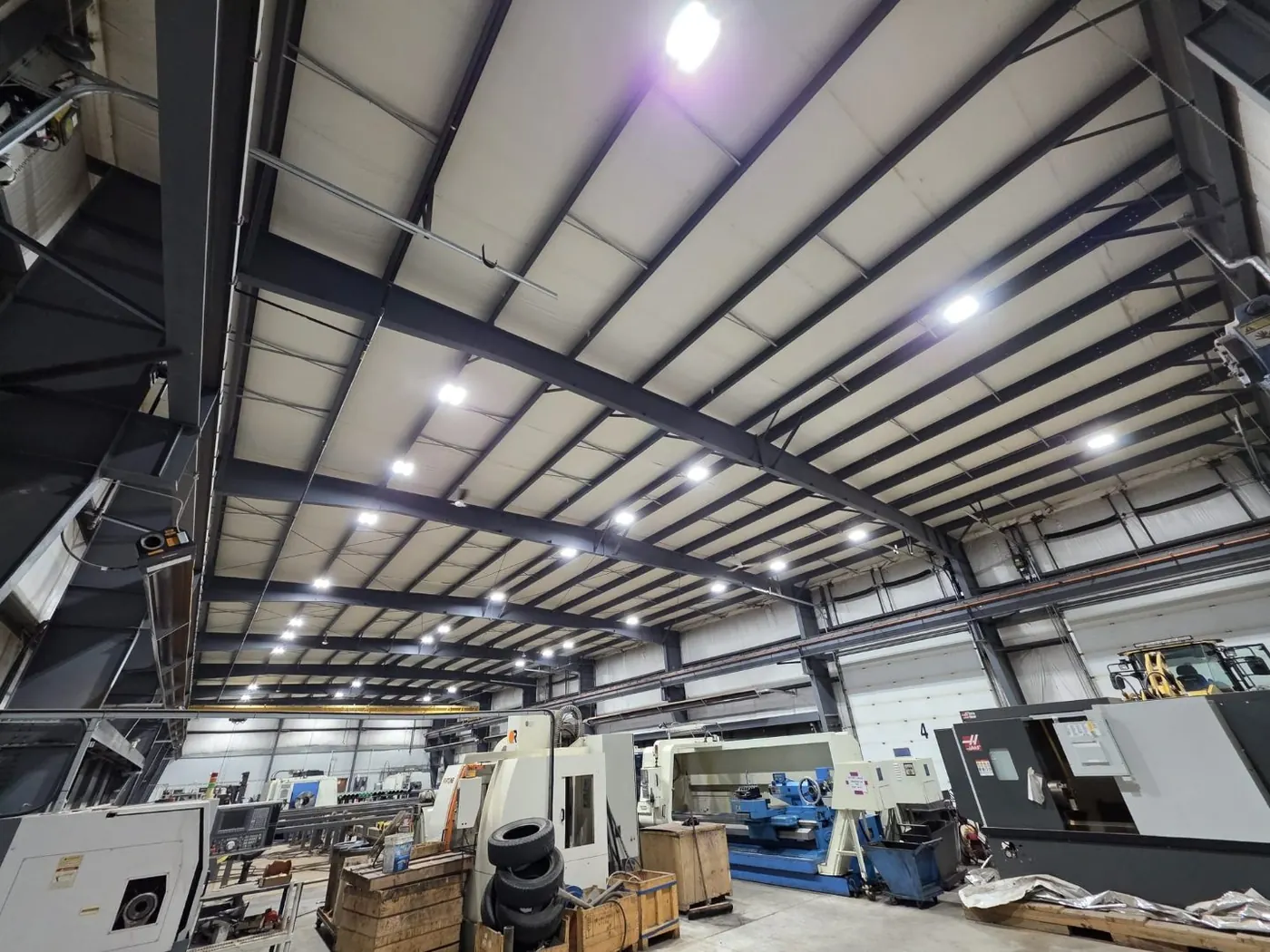
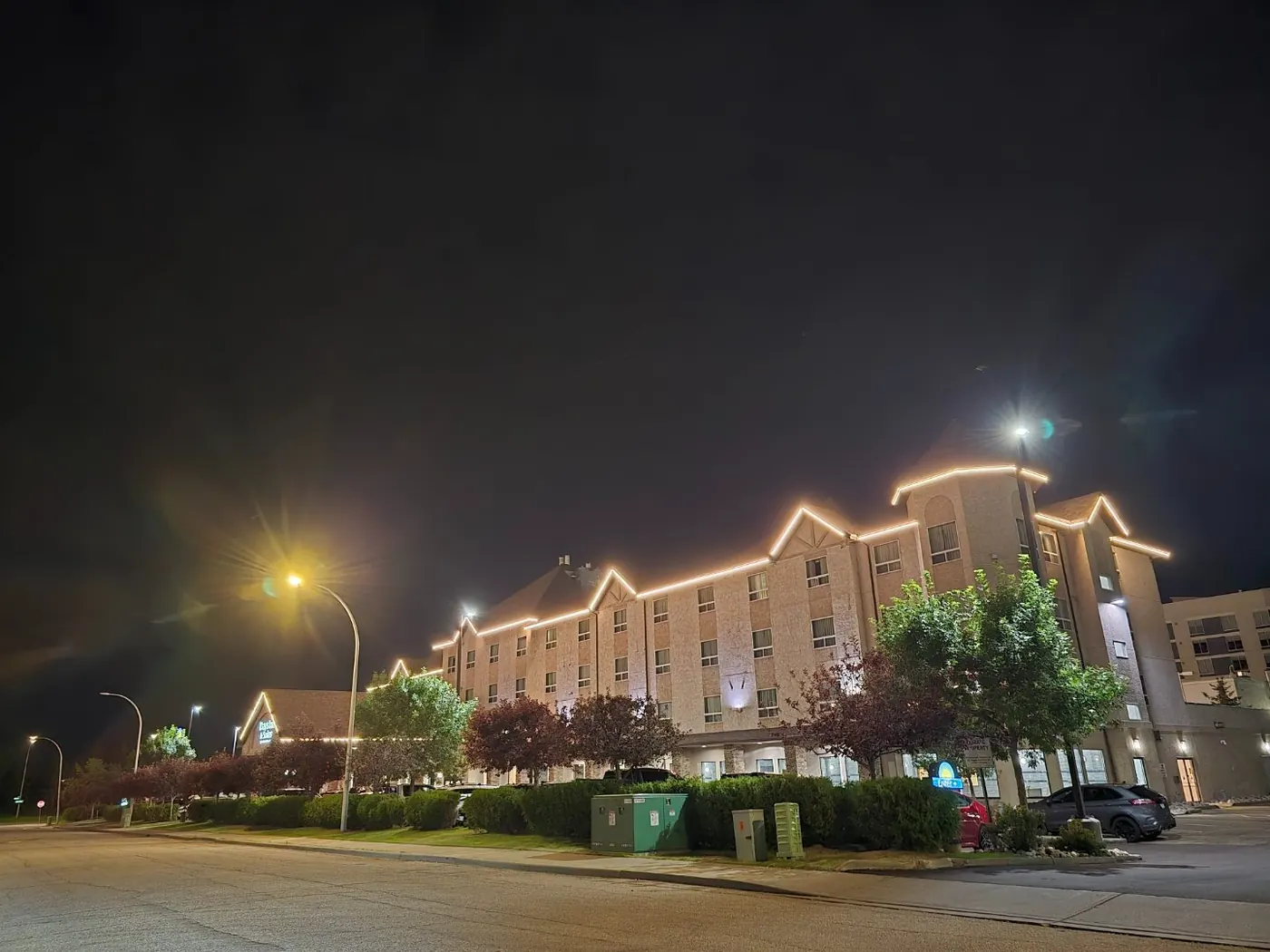
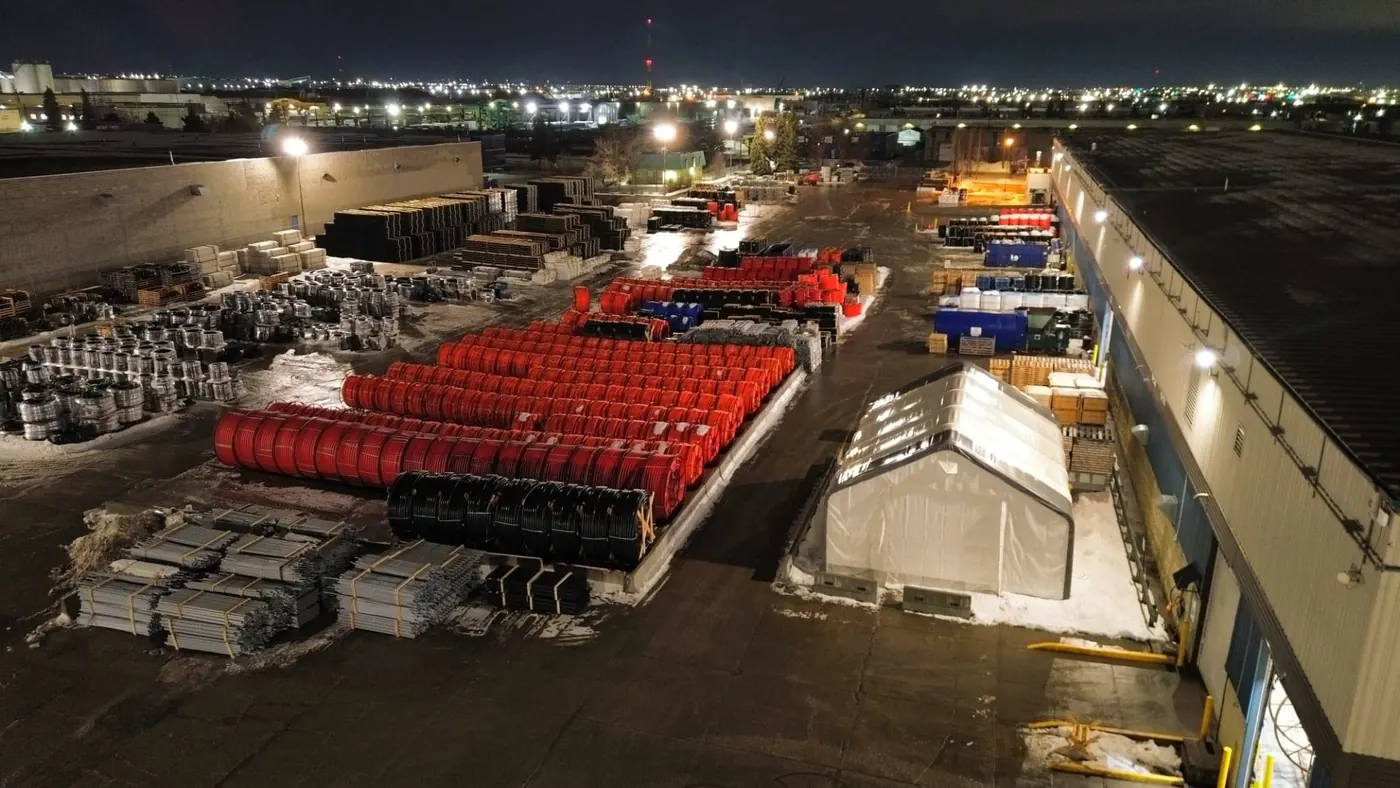
Step one, and it is free
Book a commercial LED walkdown
Tell me what the building is and what the lighting is doing now. I read every one of these myself. Then I set a time to come count fixtures, check mounting height and access, and open the panel. That count is what a real price gets built on. Nothing here commits you to anything.
Who shows up
A licensed shop, not a tube reseller
Step one, every time
Why the walkdown comes before the price
A lighting job is not a lamp count.
- In one building I will find three lamp types, dead ballasts nobody logged, a corridor on a switch nobody can locate, and a boardroom on a dimmer that will not talk to a driver.
- The walkdown writes all of that down before material is ordered, so the scope you approve is the scope that gets built.
Fixture types, counts, and lamps per fixture
Counted, not estimated. Area by area, so the office grid and the shop bays are priced as the different jobs they are.
Nameplates and actual wattage
Two identical looking troffers can sit 20 percent apart on draw depending on the ballast factor. I read the plate, and I meter where the plate is gone.
Great Lakes Energy lighting wattage guideFixture condition, lenses, sockets, ballasts
A yellowed lens on a good housing is a cheap fix. A cracked housing is not worth a retrofit kit, and that decision changes the price per fixture.
Each area on its own merits
Offices, public areas, corridors, shop, warehouse, exterior. Different light levels, different colour temperature, different answer.
IES recommended light levels compilationRecessed count and opening size
A 4 inch retrofit only fits if the opening and the existing housing let it. Counted and measured, not assumed off a drawing.
Ceiling height, lifts, furniture, protection
A 24 foot bay needs a lift on site and a plan for where it drives. A boardroom needs the table covered. Both cost money, so both go in the scope instead of showing up later.
Mandel Rentals boom lifts EdmontonSwitching, sensors, dimming, emergency and exit
This is the part that bites low bidders. Occupancy sensors and dimmers built for a fluorescent load do not always drive an LED load, and emergency and exit units have their own rules.
LEDVANCE SubstiTUBE sensor compatibilityOperating hours, area by area
A corridor that never shuts off and a meeting room used twice a week do not save the same money. Hours are the input that moves the estimate most, so I get them from you instead of guessing.
Product availability and substitutions
If the specified product is eight weeks out, you find out at the scope stage, with the substitution written down, not on install day.
Lamp and ballast disposal
Fluorescent tubes and older ballasts get handled the way the scope says, through a permitted facility. Older ballasts can carry PCBs and those have their own rules.
Aevitas lighting recycling ECCC PCB rules for electrical contractorsPublic access, security, and after hours
Who unlocks it, who has the alarm code, where the crew parks, and which rooms cannot be closed during business hours. Phased so your day keeps running.
Staging, travel, and mobilization for out of town
Where the material lands, how it gets there, and how many days the crew is on site. Planned before anybody drives, not invoiced as a surprise after.
This is the standard process, not an upsell
The walkdown protects your budget more than it protects mine. A missed fixture count and a hidden ceiling condition are the two things that turn a clean lighting job into a change order, and both of them are found by walking the building with a clipboard.
Three ways to do it
Choose the upgrade that fits the building, not the brochure
I do not push every building into one product. After the walkdown you get the options that actually apply, with what each one does to the light, the maintenance, and the money. Some fixtures come off the list entirely because they are fine.
| Path | Best fit | What happens to the fixture | What you notice |
|---|---|---|---|
| LED tube retrofit | Large counts of housings that are still in good shape and a lower opening investment | Housing stays. Fluorescent system converted to LED tubes. Ballast bypassed or removed depending on the system chosen. | Lower draw, and no more buying tubes. Where the ballast stays in, the hum stays in too. |
| New flat LED panels | Offices, reception, libraries, council chambers, anything the public sits in | Old fluorescent fixture comes out. New panel, new driver, new optic goes in. | Best light quality and the cleanest ceiling. More labour, so it costs more per fixture. |
| 4 inch recessed retrofit | Smaller offices, corridors, reception areas already on recessed cans | Compatible opening kept. Old lamp and trim replaced with a flat LED retrofit unit. | Low profile modern ceiling and fewer lamp changes. Only works where the opening and housing allow it. |
| Final recommendation on all three is confirmed after the audit. Compatibility, conversion method, and the real per fixture number depend on the existing fixture, the wiring, the ballast condition, and the product selected. | |||
One thing that decides this for you in a lot of Alberta buildings
Most commercial lighting here runs at 347 V, and Alberta STANDATA 24-ECB-030 restricts double ended lamp retrofits at 347 V. When that is what you have, a new fixture is often the compliant answer rather than the fancy one. I confirm your voltage on the walkdown before recommending anything.
Alberta STANDATA 24-ECB-030For rooms people sit in
Grey outside all winter. Blue sky in the ceiling.
Sky panels go into a regular 2x2 drop ceiling, in the same openings the old flat panels sat in. Offices, break rooms, waiting rooms, anywhere people sit under a grid ceiling all day.
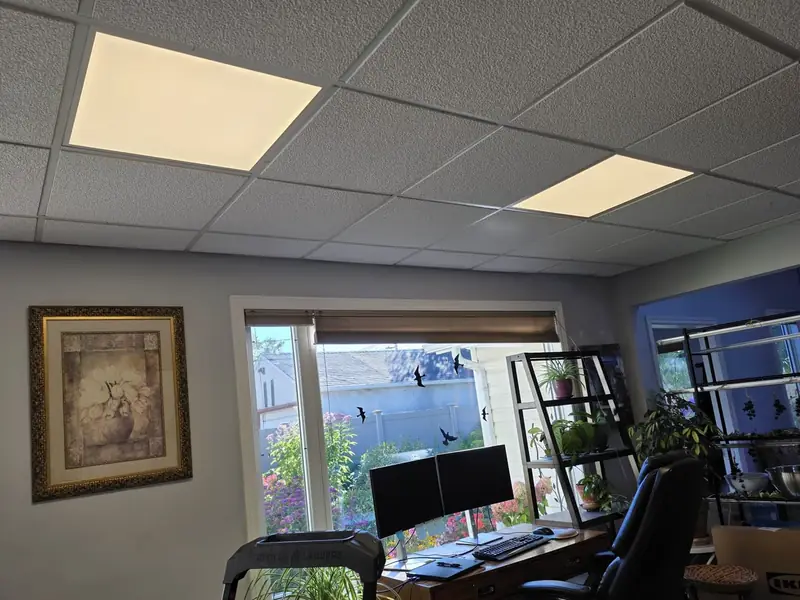
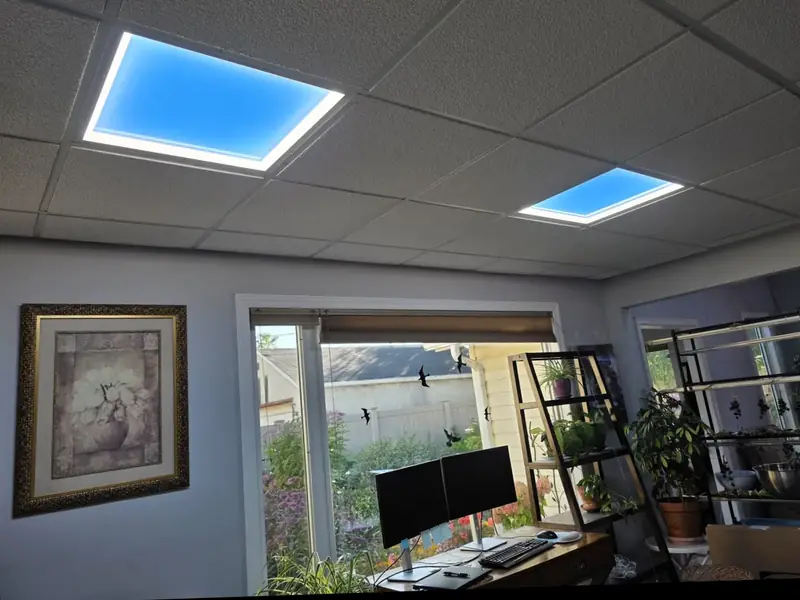
Same office, same ceiling grid
An upstairs office in an Edmonton home. Two flat 2x2 panels came out, two Feit Vista sky panels went into the same openings. No drywall. Tap the wall switch for sky, plain white light, or both.
| Old fixture | Old watts | With a sky panel |
|---|---|---|
| Fluorescent 2x2, three U bend lamps | 108 W | Cuts about a third |
| Fluorescent 2x2, two U bend lamps | 72 W | A wash. You are buying the room, not the bill |
Before you fall for them
The manual limits these to ceilings that are not fire rated, so I check that at the walkdown, along with whether your grid takes them. On most buildings I end up doing both. Sky panels where people sit and look up, plain panels where the room just needs light.
The watts math, on the LED upgrades pagePlanning ranges
What this costs, before I have seen your ceiling
Most commercial lighting pages will not post a number. I will, on one condition: these are planning ranges tied to a stated fixture count, not your quote. The low end of every band is pinned to a job I have already invoiced, so it is a real price somebody actually paid, not a number that sounds good.
| Path | Per fixture | 40 fixtures | 104 fixtures |
|---|---|---|---|
| LED tube on the existing ballast | $105 to $135 | $4,200 to $5,400 | $10,920 to $14,040 |
| LED tube, ballast removed | $179 to $215 | $7,160 to $8,600 | $18,616 to $22,360 |
| New LED panel, one for one | $241 to $275 | $9,640 to $11,000 | $25,064 to $28,600 |
| 4 inch recessed retrofit | Priced after the count | Depends on opening and housing | Depends on opening and housing |
| Six and eight lamp fixtures carry more material and land higher. High bays are a different band again and get quoted per building. Lift rental, after hours work, disposal volume, and travel are scoped separately because they are real costs and hiding them in a per fixture number is how you get surprised. | |||
Why I will post a range when most shops will not
Because you need to know whether this is a $5,000 conversation or a $28,000 one before you book anything, and making you sit through a sales call to find that out is a waste of your afternoon. The firm number comes off the walkdown. Nothing on this page is a quote.
Those bands are planning numbers. Your building decides where inside them you land.
Free, usually 30 to 45 minutes on site, and you get the fixture count, the options and the assumptions in writing. A Master Electrician does the walkdown, not a sales rep, and nothing gets signed that day.
Or go straight at me. Call (780) 904-3462Text me instead
What it may save
Where the savings actually come from
A fluorescent system burns power in the lamps and again in the ballast. LED cuts the connected load, and it also cuts the tube and ballast replacements you are quietly paying for every year. How much depends on what is up there now, which is exactly what the walkdown measures.
The disclaimer, in plain words
Energy, maintenance, operating cost, incentive, and payback figures on this page are estimates until the existing system, the operating hours, the selected products, and your applicable electricity charges are confirmed.
- Fixed charges and demand charges do not fall in step with lighting energy, so a 50 percent lighting cut is not a 50 percent bill cut.
- Anybody who tells you otherwise has not read your bill.
The arithmetic, if you want to check it yourself
Existing connected load in kilowatts is fixtures times lamps per fixture times lamp watts times one plus the ballast loss allowance, divided by 1,000. A four lamp fixture on 32 W lamps with a 12 percent ballast allowance works out to 143 W, which is why a metered plate matters more than a lamp rating.
The LED side is fixtures times tube watts times lamps, or fixtures times panel watts for a one for one panel swap. Annual kilowatt hours is load times hours run per year. Annual dollars is kilowatt hours times your all in delivered rate, not the energy line on your bill. Maintenance avoided is the tubes and ballasts you stop replacing plus the labour time to change them.
That is the whole model. The calculator below runs it and shows its own assumptions.
The calculator
Put your own building in and see the range
It runs on published wattage tables for what is up there now and real prices off jobs I have already invoiced. It answers in a range instead of one confident number, because until I meter a fixture I do not know where inside the wattage band yours sits. Every assumption it uses is visible and every source is linked.
This is a planning calculator, not a quote. A firm recommendation needs an onsite fixture audit, a nameplate review, confirmed operating hours, and a look at the charges on your own bill. Want it on its own page to send to your accountant or your board? Run the calculator. Every result has a shareable link.
How the job runs
Five stages, and you know what happens in each one
Walkdown and fixture audit
I document the existing lighting, fixture condition, nameplates, controls, ceiling access, operating schedule, and the areas the work has to happen around. You get the count in writing.
Options and a documented scope
Tube retrofit, new fixtures, recessed retrofit where it applies, each priced off the confirmed conditions. Written so you can compare it line for line against anybody else's number.
Energy and maintenance review
Existing load against the proposed system, using your hours and your rate, plus the tube and ballast replacements you stop paying for. A planning estimate off verified inputs, labelled as one.
Schedule and mobilize
Material, crew, lifts, staging, access, safety, and work hours all sorted before anybody shows up on site. For out of town work the crew arrives with everything, because a second trip is my problem and my cost.
Install, test, close out
Install, test the lighting and the controls, clean the areas we worked in, handle the disposal the scope specifies, then walk it with you before I invoice. Permit and inspection where the work needs one.
Out of town
Projects outside Edmonton get planned harder, not priced looser
A missed count in Edmonton costs an hour. A missed count in Vermilion costs a day and a half plus fuel. That is why the pre construction walkdown matters more on an out of town job, not less, and why I will drive out for it before quoting.
Crew and material transport
What goes on the truck, and the spares that go with it so a broken lens does not stop the day.
Access, keys, alarms, parking, contact
Named person, working phone number, and a plan for the door at 6 a.m. Sorted before we leave.
Accommodation where the days require it
Planned into the schedule up front and stated in the scope, so it is never a line you find later.
Sequencing around occupied space
Offices, libraries, public areas, shops, warehouses. We phase it so the room you need tomorrow is done today.
Staging and packaging removal
Where material lands, and where the cardboard goes. It leaves with us.
Lamp and ballast disposal, cleanup, final walk
Tubes and removed components handled as the scope specifies. Daily cleanup, testing, and a walk with your contact before the crew leaves town.
Straight answers
What facility managers ask me first
What is the difference between an LED tube retrofit and new LED panels?
A tube retrofit keeps eligible existing fixture bodies and converts the system to LED. New flat panels replace the fluorescent fixture entirely, so you get a new fixture, driver, and optic. Retrofits are usually the practical value option. Panels usually give you the cleaner finished ceiling. Fixture condition, the space, the finish you want, and the budget decide it, and I will tell you when the cheaper one is the right one.
Will this actually cut our power bill?
Lighting energy goes down. Your bill has other things on it. LED uses less electricity than an older fluorescent system, and how much less depends on the existing lamps, the ballasts, the fixtures, your hours, your controls, and the product selected. Fixed charges and demand charges do not drop in step with lighting. I verify the inputs on the walkdown and give you a project specific planning estimate rather than a percentage off a brochure.
Can you give me a price without coming out?
I can give you a planning range off photos and a rough count, and the ranges on this page are real ones. Final commercial pricing needs the site. That is where quantities, fixture condition, access, scheduling, disposal, controls, and the site specific work get verified. Anybody who firms up a commercial lighting price over the phone is either guessing or padding.
Do you remove the fluorescent ballasts?
Depends on the system selected and the fixture condition. Where the retrofit calls for it, ballasts are bypassed or removed as part of the electrical conversion, and that is the version with nothing left in the fixture to fail or hum. Where the ballast stays, it keeps drawing power. Either way the approach is written into the scope so you know which one you bought.
Can you work around our office, library, shop, or public hours?
Yes, and it gets planned at the walkdown, not negotiated on day two. We go through operating hours, public access, sensitive areas, furniture and equipment, and any scheduling constraints, then phase the work so your day keeps running. After hours and weekend work is available and it is priced honestly rather than buried.
Do you handle the old tube disposal?
The scope names what comes out and how it is handled. Fluorescent lamps and removed lighting components go through the process the approved scope specifies, at a permitted facility. Older ballasts can contain PCBs and those carry their own federal requirements, which is another reason the walkdown looks at ballast vintage.
Are there rebates for commercial LED upgrades?
Programs change, funding runs out, and eligibility varies by site, customer class, equipment, and timing. I will review what might apply to your project. I will not deduct an incentive from your price until eligibility and program requirements are confirmed in writing, because the shop that assumes a rebate and is wrong hands you the bill for it.
Do you work outside Edmonton?
Yes. Out of town commercial work needs advance coordination for crew travel, material transport, site access, scheduling, and mobilization, and all of that goes in the scope before anybody drives. Tell me the town when you book and I will tell you honestly whether I am the right shop for it.
Options, With The Reason For Each
What the walkdown is choosing between
We do not price a commercial lighting job off a fixture count in an email. The walkdown exists to pick between these three, and to measure the one number that decides what is even legal in your building.
Option 1
Swap what is already there
Best when one ceiling type through the building, fixtures in good shape, and the lowest number is what matters.
Least material, most fixtures per day, least disruption to your staff. On a clean open space this is the fastest crew tempo we get.
You inherit the condition of every housing and lens we leave in the ceiling.
Option 2
Replace the fixture
Best when the space is under lit now, or the lenses have gone yellow and staff complain about it.
You cut more load and you get a warranty on a whole fixture rather than on a lamp inside somebody else housing. On a full building this often pays back in the same window as the cheaper path.
Higher material cost, and hard ceilings need mounting hardware that a lamp swap does not.
Option 3
Add controls and zone it
Best when the lights run long hours in areas nobody is standing in.
Hours drive your bill as hard as watts do. Occupancy and daylight control cut the hours, and that saving stacks on top of whatever the fixture change already saved.
Controls add commissioning time, and the existing wiring has to be able to carry them.
One measurement comes first, before any of the three. We meter the voltage at an actual fixture, because 347 volt is common in Alberta commercial buildings and it changes which products are legal and whether the cheap path exists at all. We measure it. We do not assume it.
5.0 on Google
What business customers say
Nobody has left us a review on a commercial lighting retrofit yet, so I am not going to show you one. These two are real, from a business customer and a repeat electrical customer.
Swipe sideways for 1 more →