LED worked example, Edmonton shop
104 Fixtures, 20.0 kW Down to 6.2 kW
Take a shop in Edmonton. 104 four lamp T12 fixtures sitting on magnetic ballasts, which puts the connected lighting load at 20.0 kW. This one is a worked example, not a job I am claiming.
The fixture type, the wattages and all four option prices are the real numbers I quote from, and here they all are, including the one I would pick.
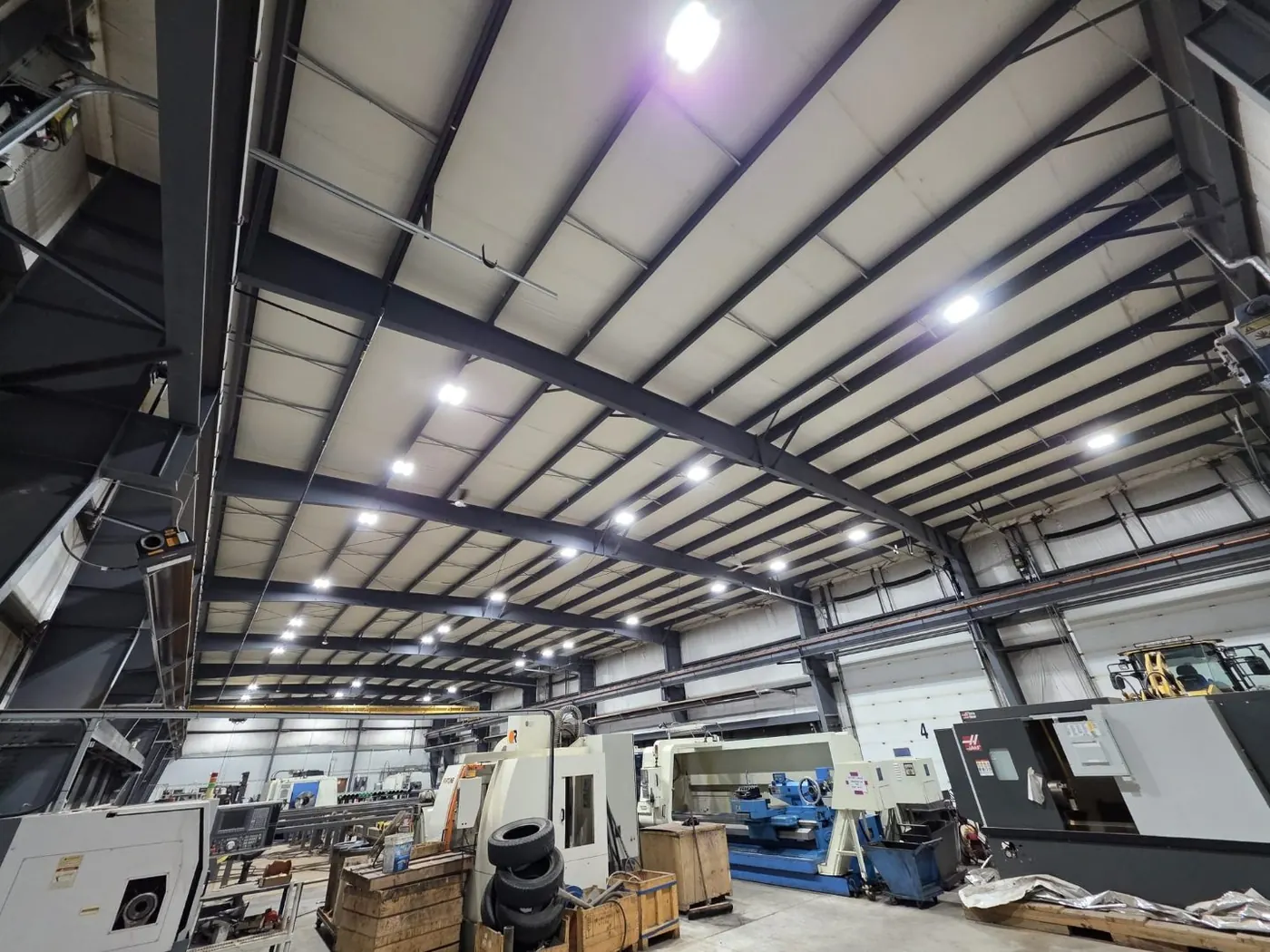
The walkdown
104 four lamp T12 fixtures on magnetic ballasts
On your building I count every fixture myself, then meter the connected lighting load instead of adding up nameplates. That reading is the only reason an after number means anything. This example is built on that same method.
The part nobody quotes
Magnetic ballasts fail on their own schedule. That never shows up on a power bill. It shows up as a man on a ladder, and it is the line most lighting quotes leave out entirely.
5.0 on Google
What business customers say
Nobody has left us a review on a commercial lighting retrofit yet, so I am not going to show you one. These two are real, from a business customer and a repeat electrical customer.
Swipe sideways for 1 more →
What I quoted him
Four Options on One Page, $11,443 to $26,242
I do not hand a shop one number. Four ways to do the same 104 openings, with the load after each one and what each one saves, so you can work out for yourself whether the cheap option is actually cheap.
- Load after
- 7.3 kW
- Per fixture
- $105 to $135
- Bill a year
- about $5,329
- Load after
- 6.2 kW
- Per fixture
- $179 to $215
- Bill a year
- about $4,526
- Load after
- 5.2 kW
- Per fixture
- $241 to $275
- Bill a year
- about $3,796
- Load after
- 6.0 kW
- Per fixture
- $490 to $540
- Bill a year
- about $4,380
Before was 20.0 kW metered, so 73,000 kWh and about $14,600 a year. Every after figure is that option’s load times 3,650 hours times 20 cents a kWh delivered. Per fixture prices are installed, all in. Across the four options the quote spans $11,443 to $26,242.
The cheapest option pays back fastest, and I still did not recommend it
Option one pays for itself in about a year and a half on paper. Whether that is smart depends entirely on one thing:
Keeping the building means option two. Ballast out, nothing left in the fixture to fail, and 69 percent off the lighting load. Showing you all four is the only way you can see that for yourself.
Dmitry Naboka, Master Electrician #13824, 14 years in the tradeFour options on one real building. Yours needs its own four.
Free, usually 30 to 45 minutes on site, and you get the fixture count, the options and the assumptions in writing. A Master Electrician does the walkdown, not a sales rep, and nothing gets signed that day.
Or go straight at me. Call (780) 904-3462Text me instead
Metered, before and after
What Changes on a 104 Fixture Shop
Option two, the one I would pick. Same 104 openings, same ceiling, same aisles.
| T12 on magnetics | LED tube, ballast out | |
|---|---|---|
| Fixtures | 104 | 104 |
| Watts a fixture | about 192 W | 60 W |
| Connected lighting load | 20.0 kW | 6.2 kW |
| Run hours a year | 3,650 | 3,650 |
| Power a year | 73,000 kWh | 22,630 kWh |
| Lighting cost a year | about $14,600 | about $4,526 |
| Saved every year | about $10,074, a 69 percent cut | |
Where every number above came from:
20.0 kW and 6.2 kW: loads, metered and specified
192 W a fixture: that 20.0 kW across 104 fixtures
The dollars: 3,650 hours at 20 cents a kWh delivered
Not counted: brighter light, service calls you stop paying for
Yours will not be identical, and this one is an example, which is exactly why I meter your shop before I price it. I have not tried to put a dollar figure on the last one.
The rest of it
What the power bill does not show
There is no rebate on this work, and there is none on yours
Energy Efficiency Alberta was wound up in 2020. The Emissions Reduction Alberta Energy Savings for Business money is closed and fully allocated. SEMI is industrial only. If a payback number you are looking at has a rebate line in it, that payback is made up.
ERA Energy Savings for Business program overviewHow the job runs
One walkdown, one Master Electrician
About an hour on site, and it all happens before you see a single price.
I count the fixtures myself
All of them, by hand, noting the lamp type and the ballast on each run. A fixture count off a floor plan is a guess, and a guess is how a quote turns into a change order.
I meter the load and read the light
Connected lighting load on a meter, not a nameplate total. Light level at the bench and on the floor, ceiling height on a tape, supply voltage confirmed. That before reading is what makes an after number honest.
Then you get four prices, not one
Same 104 openings, four ways to do it, with the load and the payback beside each. I tell you which one I would not do, and why.
My crew does the work and pulls the permit
Five person crew, no subcontractors. Old tubes and ballasts leave with us. My name is on the permit, which is the reason I will not sell an option I would have to come back and fix.
We are a young company. That is exactly why my name is on the permit for every one of these, not the excuse for anything.
Who is actually in your ceilingStraight answers
What shop owners ask me about this job
How did you get 20.0 kW?
I metered the connected lighting load instead of adding up nameplates. 104 four lamp T12 fixtures on magnetic ballasts came out at about 192 W each, and that includes what the ballast draws on top of the four lamps.
Why not the cheapest option?
Option one leaves the magnetic ballast in the fixture. It still draws power and it is still the part most likely to fail. It pays back fastest on paper and it is the wrong answer on a building you are keeping.
Will my shop save the same $10,074?
Almost certainly not. That number comes from 104 fixtures, 3,650 run hours and a rate near 20 cents a kWh delivered. Change any one of those and the answer moves, which is why I meter your shop before I quote it.
Is there a rebate on this work?
No. Energy Efficiency Alberta wound up in 2020 and the ERA Energy Savings for Business money is fully allocated. SEMI is industrial only. The capital cost allowance is real, Class 8 at 20 percent declining balance, and your accountant claims it.
ERA Energy Savings for Business program overviewWhat happened to the old tubes and ballasts?
They leave on my truck. Tubes go to the Edmonton Eco Station at a dollar a tube, and pre 1980 ballasts get handled as PCB waste. That cost is inside the price you already saw.
Edmonton Eco Station accepted items and feesEnvironment and Climate Change Canada, PCB rulesWho does the install?
My own five person crew. No subcontractors. I pull the permit and my name is on it.
Next step
Book the walkdown
Free. About an hour.You get a written scope with the option prices side by side.
What I measure while I am there
- 1
I count your fixtures
- 2
I meter the load you have now
- 3
I hand you the options side by side with what each one saves
No pressure, and no rebate that does not exist.
Booked. I have your number.
I will call you the same day, or first thing next morning, to set the time. If you want it sooner, call or text me at (780) 904-3462.
I do the walkdown myself. I meter a fixture, count what is actually up there, read your municipal lighting bylaw before I show up, and hand you a written scope with the option prices side by side. No pressure, and no rebate that does not exist.
Dmitry Naboka, Master Electrician #13824, 14 years in the tradeMore on the LED work
- Commercial buildings, the whole upgrade offer
- Put your own fixture count and rate into the calculator
- Shop and fabrication lighting, the service page
- Every building type and the price bands, in one place
- The full retrofit guide, wattage tables and code notes
- Warehouse and high bay, where ceilings clear 20 feet