Rooftop solar, LiFePO4 battery banks, pure sine inverters, 30A/50A shore power, and Starlink-ready DC power built for camping along the North Saskatchewan River, acreage and cabin off-grid, and oilfield rotations, plus cold-weather lithium for the shoulder season.
★5.0 Google
verified reviews
Licensed in Alberta
Tesla Wall Connector
★★★★★5 out of 5 stars. Hayden Corbin, Google review
Dmitri did an awesome job on the electrical for our hot tub. Highly recommend getting work done through him.
One system that runs your whole rig anywhere the road ends. Panels charge the battery, the battery runs your Starlink, TV, fridge, and lights, and the bank recharges from the sun, while you drive, or while you are plugged in. Camp self-sufficient all summer.
Step 1 · Capture
Rooftop Solar Panels
Rigid or flexible panels with Maximum Power Point Tracking. The smart version of the tap on the hose. charge controllers, sized to your roof and daily load. Free power every sunny day.
Step 2 · Store
LiFePO4 Battery Bank
Lithium banks that hold roughly 3x the usable power of Absorbed Glass Mat. The heavy lead battery RVs used before lithium. at half the weight, and hang on to it overnight and on cloudy days.
Step 3 · Convert
Pure Sine Inverter
Clean AC power for your TV, coffee maker, microwave, CPAP, and tools, with DC circuits ready for your Starlink dish.
Step 4 · Live
Starlink-Ready Power
We wire, power, and mount your Starlink so it runs off-grid. Internet, streaming, and work-from-the-lake, no hookup required.
Recharges three ways: from the sun, while you drive off the alternator, or while you are plugged into shore power. Glamping, boondocking, or full-time. You stay powered.
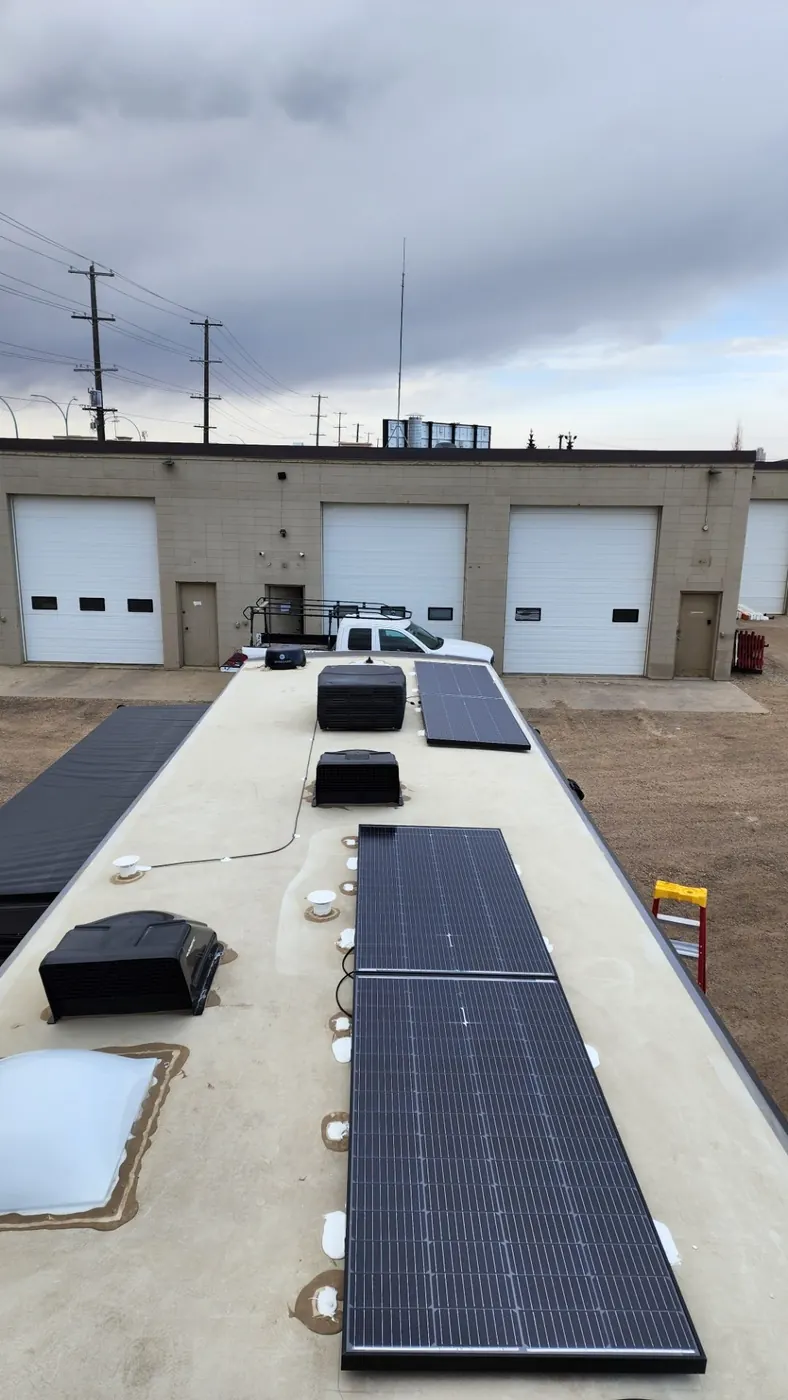
On the roofTwo panels mounted and sealed on a motorhome.
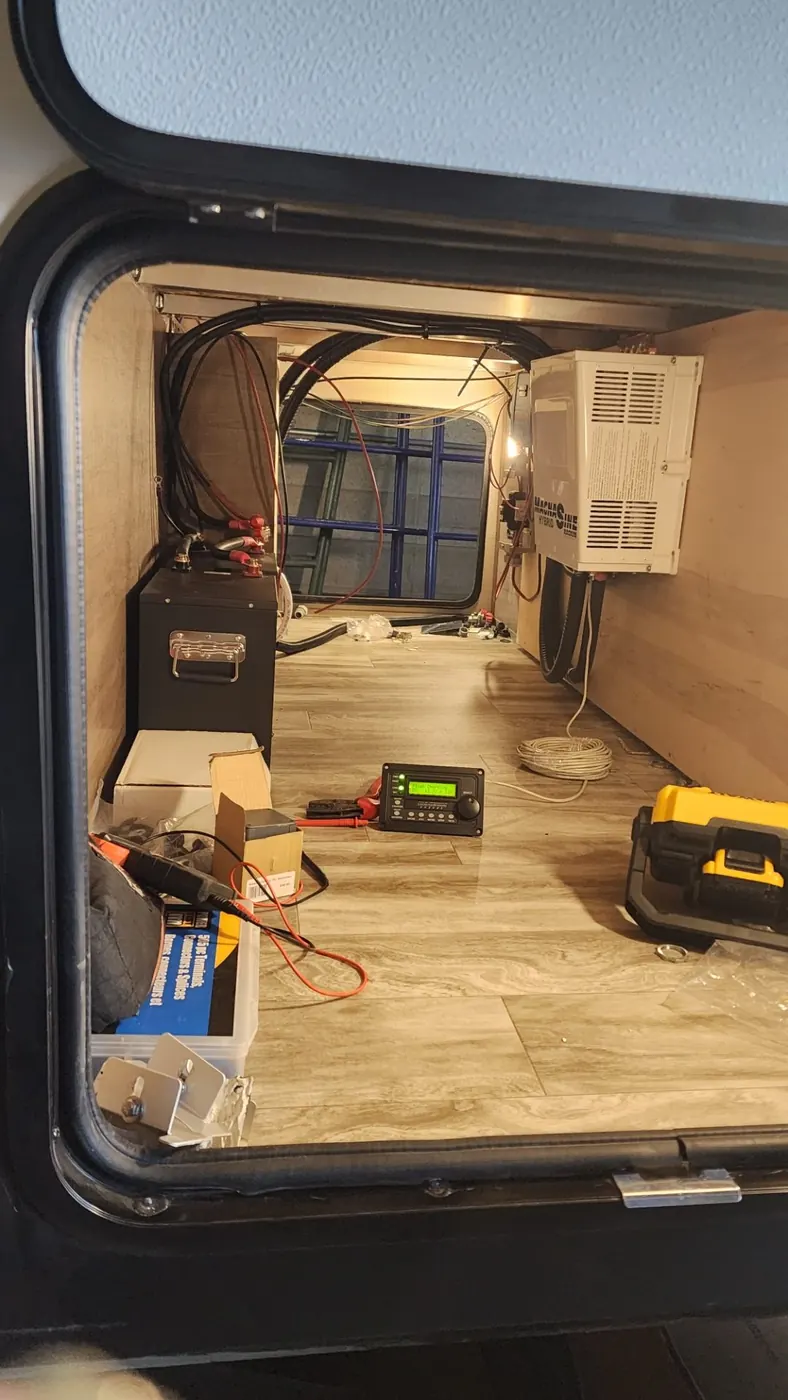
The battery bankFour lithium batteries. The screen shows what is left.
Mid installThe storage bay before the wiring gets tidied.
Laid out firstPlaced to clear the vents and the air conditioner.
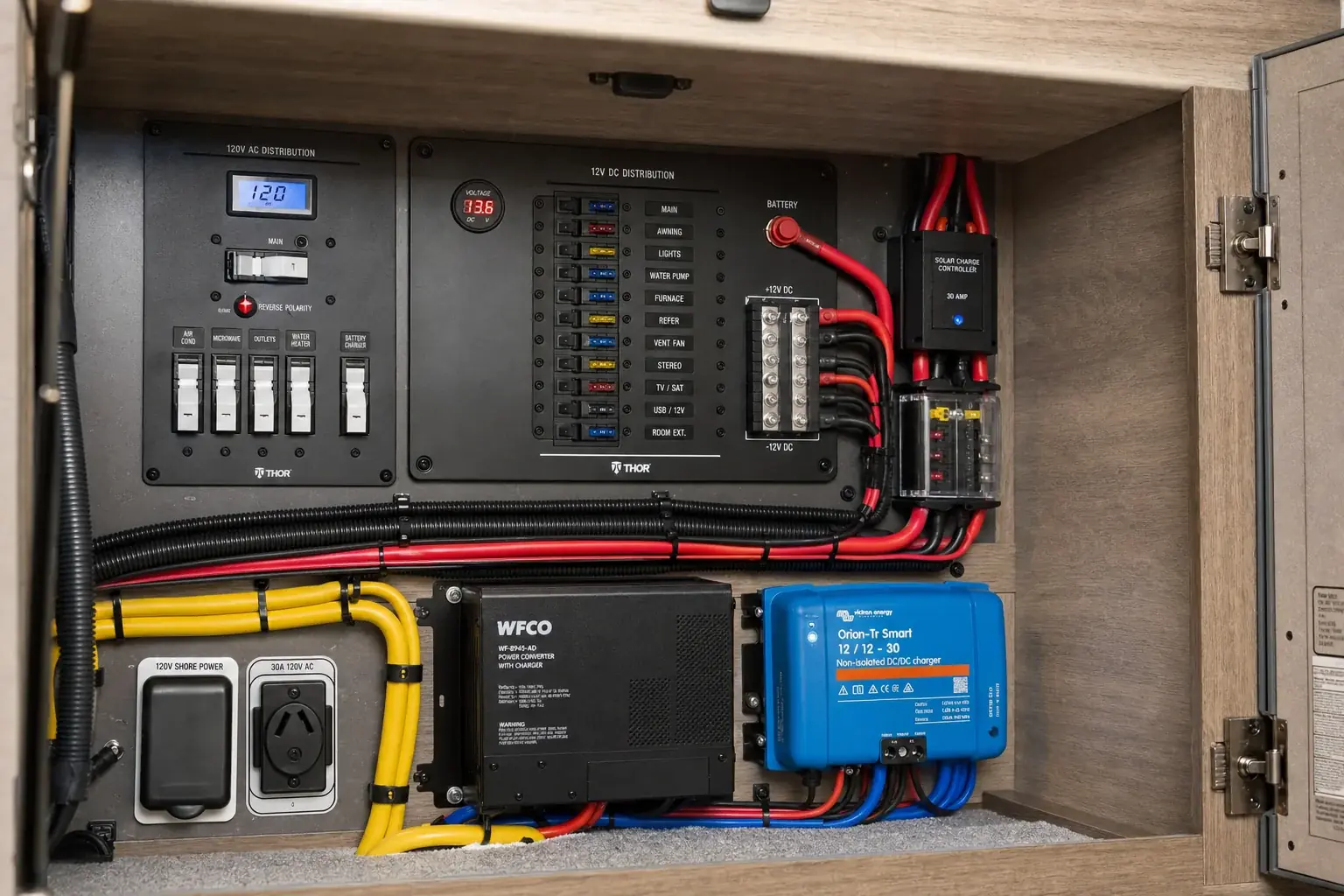
Every circuit labelledFurnace, fridge, water pump, lights.
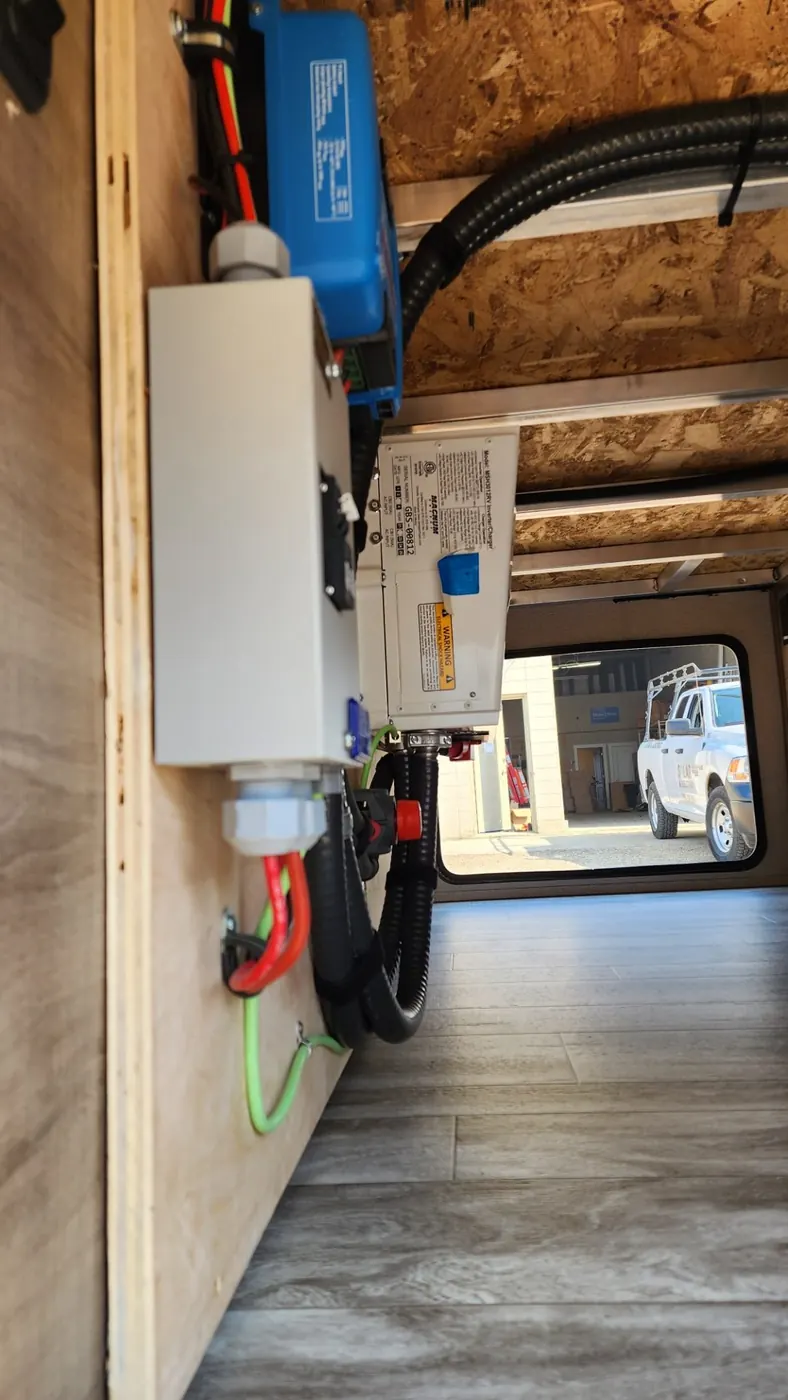
Shore powerPlug into the post. The batteries top up on their own.
Straight Talk
“Can’t I just buy a kit off Amazon?”
Drayton Valley sits along the North Saskatchewan River about an hour and a half southwest of Edmonton, in acreage, river, and oilfield country where a lot of properties already run partly off-grid. Get out past town and the nearest big-box installer is a fair haul.
The honest answerRead what the kit leaves outFour questions we get every week
Gary asks: “Can’t I just buy a kit off Amazon and DIY it?”
You can, and plenty of people do. The problem is what the kit instructions leave out. We get called out to fix DIY jobs all the time: screws through the roof membrane that leak the next spring, undersized or missing fuses that turn a lithium bank into a fire risk, and connections that void the panel or battery warranty. A licensed electrician sizes the wire and fusing to code, seals every roof penetration properly, and leaves you with a system that’s safe and actually warrantied.
Honest version: if you love the project and know your amps, DIY the fun parts. Let a licensed electrician handle the roof penetrations, the battery fusing, and the shore-power tie-in.
Mike asks: “Do I really need an electrician for RV solar?”
For a single 100W trickle panel? No. For a real off-grid system that runs a fridge, inverter, and Starlink? It matters more than people think. Lithium banks store a lot of energy, and a wrong fuse, undersized cable, or sloppy ground can start a fire in a space you sleep in. An electrician gets the DC design, the AC tie-in, and the grounding right the first time. And if your insurer or campground ever asks, the work stands up.
Honest version: the panels are the easy part. The wiring, fusing, and inverter tie-in are where a licensed electrician earns their keep.
“What’s the difference between you and an RV repair shop?”
Most RV shops are great at slides, plumbing, and appliances, and they’ll bolt on a kit. We’re a licensed Master Electrician who does solar, batteries, inverters, and shore power as our actual trade. The same standard we hold on a house panel. Code-compliant, permitted where required, and built so your whole electrical system talks to itself instead of fighting.
Honest version: we’re not cheaper than a big-box kit. We’re the crew you call when you want it done once, done right, and done safe.
A kit that quits in the city
A kit that quits out on the acreage
Return counter is 20 minutes away
Nearest big-box installer is hours behind you
You sleep at home that night
No fridge, no furnace fan, no water pump
Swap the part, try again next weekend
Trip is over, and you tow it home to find out why
That distance is the whole reason the fusing, the wire sizing, and the cold-weather protection have to be right the first time in Drayton Valley.
The Raydn Renewables Standard. 12 points, published.
Every system we build gets held to the same twelve build points. It is the checklist my name goes on.
The smaller job
A $40,000 mobile home
The bigger job
A $4 million house
=
The same twelve build pointsNot a badge. Not a brand name. The same standard on both, because it is the same electrician signing off.
12 pointsRead the whole standardEvery one of them, in writing
01
Load-first design, not package-first
We size the system to your real loads and how you actually camp, then scope the smallest build that honestly solves the runtime problem. You do not pay for a package you will never use.
02
Wire and fusing sized to code
Conductors, breakers, and fuses are sized to the actual current, not eyeballed. Every conductor gets overcurrent protection rated for it. That is the difference between a system that lasts and one that melts a lug.
03
Class-T fuse on the battery main
A lithium bank can dump thousands of amps into a dead short. The battery main gets a Class-T fuse with the interrupt rating to actually break that fault. This is the one most kits skip, and it is the one that starts fires.
04
Controller headroom for Alberta cold
Panel voltage climbs as it gets colder. A cold Alberta morning can push a string near 90V open-circuit, so we spec a charge controller with the voltage headroom to take it. Undersize this and a cold snap kills the controller.
05
Panels fastened to structure, sealed for good
Big dual-glass modules go on rails fastened into roof structure, not stuck on with corner brackets. Every penetration is sealed to a standard that does not leak by spring. A leaking roof screw is the cheapest mistake to make and the most expensive to fix.
06
Shore power passes through clean
The inverter/charger is wired so 30A or 50A shore power passes straight through and charges the bank fast when you plug in. No fighting between shore and battery, no manual swapping. Plug in, it just works.
07
Proper grounding and bonding
DC and AC grounding done right, bonding where it belongs, so a fault trips a breaker instead of energizing your rig frame. This is invisible until the day it saves someone from a shock. We do it every time.
08
Inverter sized against the battery, honestly
A 3000W inverter can surge to roughly 5,500W, which is about 460A at 12V. We confirm the battery bank can actually deliver that surge, and we tell you plainly when the inverter can out-pull the battery. No pretending a small bank runs a big load.
09
A/C told the truth
Your rooftop air conditioner is a shore, generator, or short-burst load. It is not an all-day battery load, and anyone who tells you it is, is selling you a bank you do not need. A soft start helps the surge. Fans are your realistic all-day cooling. We say so up front.
10
Commissioned, not just connected
Roof and mechanical work is separated from the energized terminations. We check PV voltage at the panel before anything goes live, cap the charger until the battery Battery Management System. There is a small computer inside every good lithium battery. limit is confirmed, and bring the system up in a controlled sequence. Then we hand you a commissioning report.
11
Labelled so the next person understands it
Every breaker, fuse, and disconnect is labelled. You get a single-line diagram of your own system. If you sell the rig, or another electrician ever opens the bay, the whole build reads like a book instead of a mystery.
12
My name is on it
Dmitry Naboka, Master Electrician #13824. I am a Master Electrician with 14 years in the trade. I do not sub this out to a kit installer. The person who designs your system is the person who stands behind it.
Twelve points, same on every build. That is the RR Standard. Ask any RV shop for their written build standard and watch what happens.
Ten things worth knowing about RV and off-grid power, with the real numbers behind them. Read these and you will out-know most of the people trying to sell you a kit. That is on purpose.
Plain languageOpen the libraryBatteries, inverters, panels, wiring
5.1 · Battery chemistry
Lithium gives you about 3x the usable power of AGM
A 100Ah AGM only gives you about 50Ah before you damage it. A 100Ah lithium gives you 90 to 100Ah, at roughly half the weight, and it lasts far more cycles. That is why we build in LiFePO4.
5.2 · Bank sizing
A 320Ah 12V lithium bank holds about 4,096 Wh
Roughly 4,096 Wh is enough to run a fridge, Starlink, lights, water pump, and furnace fan through a night off-grid and still wake up with reserve. This is a real number, not a brochure number.
5.3 · Cold-weather voltage
Cold Alberta mornings push panel voltage near 90V
Solar panels put out higher voltage the colder they get. A two-panel string that reads 74V warm can hit near 90V open-circuit on a cold morning. We spec a 150V controller so a cold snap never over-volts it. Skip this and you buy a controller twice.
5.4 · Inverter surge
A 3000W inverter can pull about 460A at 12V on surge
When a motor or microwave kicks on, a 3000W inverter can surge to about 5,500W, roughly 460A at 12V. A 320Ah bank is only rated about 400A for a few seconds. We check this so the inverter and battery are matched, instead of finding out the hard way.
5.5 · Cycle life
LiFePO4 lasts about 3,000 to 5,000 cycles
A lead acid bank is worn out in a few hundred cycles. A lithium bank runs 3,000 to 5,000. For most people that is a decade of camping before you think about it again. The upfront cost is higher, the cost per year is lower.
5.6 · Recharging
Three ways to refill the bank: sun, alternator, shore
Solar tops it up all day. The alternator charges it while you drive to the next spot. Shore power fills it fast when you plug in. Three independent sources means you are almost never stuck. Most kits wire one and call it done.
5.7 · Wire sizing
Battery feeders on a 3000W build run #6 AWG or heavier
High-current DC runs need fat copper. On a 3000W build we run #6 AWG or heavier feeders so voltage drop stays low and the wire stays cool. Undersized cable is the quiet killer: it robs power and it gets hot. We size it right.
5.8 · Real solar yield
880W of panels makes roughly 3,000 to 4,000 Wh on a good day
The wattage on the panel is a peak, not a promise. In Alberta summer, 880W of panel realistically harvests 3 to 4 kWh across a day. We size the array to your bank and your loads using the real number, not the sticker.
5.9 · Shore power
50A shore gives you about 4x the power of 30A
A 30A hookup is one 120V leg, about 3,600W. A 50A hookup is two legs, about 12,000W. If you want to run the air conditioner and the rest of the rig at the same time on shore power, that is why the 50A upgrade matters. We tell you which your rig actually needs.
5.10 · A/C truth
Rooftop A/C drains a 4,096Wh bank in roughly 2 to 3 hours
Air conditioning pulls 1,200 to 1,500W. Even a healthy 4,096Wh bank runs it only 2 to 3 hours. That is why we are straight with you: A/C is a shore or generator load, or a short burst. A soft start helps the surge. For all-day off-grid cooling, fans win. Anyone who sells you a battery that runs A/C all day is not being honest.
Every system is sized for how you travel. Licensed electrician, permitted where required, Alberta code compliant.
Solar Panel Systems
Rooftop rigid and flexible panels paired with MPPT charge controllers. Sized to your battery bank and daily load.
Lithium Battery Banks
LiFePO4 banks from 100Ah up to multi-battery setups. About 3x the usable capacity of AGM at roughly half the weight.
Inverter & Charger Install
Pure sine wave inverters and inverter/chargers for running AC appliances, microwaves, and CPAP machines from battery.
Shore Power & 50A Upgrades
30A to 50A shore power upgrades, transfer switches, and proper hookup wiring for campground and home connections.
Distribution Panel Rewires
Full interior rewires, breaker panel replacements, and GFCI protection for older rigs and custom builds.
Trailer Conversions
Off-grid electrical for cargo trailer conversions, overland builds, and full-time living rigs.
Starlink-Ready DC Power
DC circuits, mounting, and battery-backed power sized to run your Starlink dish off-grid, so you keep internet anywhere you park.
Who This Is For
Built for People Who Want to Go Anywhere
If you want to be self-sufficient off the grid, on the road, at the lake, or out on the land, we build the power system for it.
RVers & Weekend Campers
Skip the generator noise and the full campground. Boondock for days with quiet solar and a lithium bank that just works.
Snowbirds & Retirees
Keep the fridge, CPAP, and Starlink running wherever you park. Reliable power, sized right, with someone local who picks up the phone.
Cabin & Acreage Owners
Off-grid power for the cabin, the shop, or the back forty. The same solar-plus-battery system, scaled up for a building.
Glamping & Overland Builds
Cargo-trailer conversions, vans, and glamping setups. Clean, self-sufficient power that looks and works like a finished build.
Most of our RV clients also have a home, an acreage, or an EV. The freedom you get off-grid works just as well parked in your driveway. More on that below.
Local off-grid contextDrayton Valley off-grid context: river camping, acreages, shift rotationsHow people around here actually camp
Drayton Valley off-grid use spans river camping along the North Saskatchewan, acreages and cabins that already run partly off the grid, and oilfield rotations that do not follow a normal weekend.
Cold-weather LiFePO4 batteries matter here as much as anywhere in our service area: lithium should not be charged below freezing, and Drayton Valley shoulder-season nights get there fast.
We spec battery banks with built-in heaters or low-temperature cutoff protection so the system protects itself instead of degrading quietly on a trip where no one is checking it every hour.
Being the local licensed electrician instead of a distant installer matters most exactly when the property or site sits well outside town.
It All Connects
Love Off-Grid Power on the Road?
The same freedom works at your cabin, your acreage, and your home. Solar, battery, and EV charging are one connected ecosystem, and we build all of it, code-compliant, under one licensed Master Electrician.
Six parts make an off grid system work. Here is what each one does, without the trade talk.
1Solar panels
880W on the roof
Daylight in. Nothing spins, nothing to service.
2Charge controller
150V MPPT
Steps panel voltage down and meters it in.
3Battery
320Ah, 4,096Wh
LiFePO4. The part that lets you camp with no post.
4Inverter charger
3000W
DC to 120V AC, and the charger, in one box.
5Shore power
30A or 50A
Passes straight through. You never flip anything.
6Monitoring
Screen and app
In, out, and percent left. No flashlight.
Power runs 1 to 4, panels to your outlets. Shore power joins at 5 when there is a post, and 6 is how you read the whole thing from your chair. Tap any part below for the plain words version.
Solar panels
Fuel that pours itself in
Panels turn daylight into DC power. Nothing spins, nothing makes noise, and there is nothing to service. On a four season build we fit about 880W on the roof, which is enough to refill a The size of your power tank. battery on a normal Alberta summer day.
Charge controller
The tap on the hose
Panels put out more voltage than a battery can safely swallow. The controller steps it down, meters it in at the right rate, and backs off when the battery is full. We fit a 150V MPPT so a cold bright morning cannot overshoot it.
Battery
Your power tank
This is the part that lets you camp where there is no post. Lithium, LiFePO4, about 320Ah or 4,096Wh on the build most people ask for. It takes a much deeper drain than the old lead batteries and it weighs a third as much.
Inverter charger
One box, both jobs
Your battery holds DC. Your coffee maker wants 120V AC. The inverter converts it. The same unit is also the battery charger when you plug in, which is why we fit one box instead of two. 3000W runs a microwave and a kettle without complaining.
Shore power
The campground post
Plug in and power passes straight through to your outlets, and whatever capacity is left over refills the battery. We wire the pass through so the changeover happens on its own. You never flip anything.
Monitoring
Read it from your chair
A screen inside and an app on your phone showing what is coming in, what is going out, and how much is left in percent. No guessing and no walking outside with a flashlight. This is the part customers tell me they look at every single day.
Every one of these gets labelled inside your rig and drawn on your own single line diagram. Dmitry Naboka, Master Electrician #13824, signs the commissioning sheet before we call it done.
Off grid, or plugged in. Tap one.
Where your power comes from, hour by hour
Same trailer, three situations. Watch which parts do the work in each one.
Sunny day, off grid
The panels make DC power. The controller decides how fast to push it into the battery so nothing gets cooked. Whatever the battery does not need runs your fridge and lights straight away, in real time.
After dark
No sun, so nothing is coming in. The battery carries the whole trailer on its own. On a four season build that means the fridge, the furnace fan, Starlink and your lights until morning, with margin left.
Plugged in at camp
Shore power takes over and passes straight through to your outlets. The same box that inverts is also the charger, so it refills the battery while you sit there, then hands the load back to the battery the second the post trips.
Honest Pricing
Real ranges, not a mystery quote
Most shops hide the number until they have you on the phone. Tap the build that sounds like yours and the real range is right there.
Value grade · Raydn-sourced
Quality components we source and stand behind, chosen for the best power per dollar. Full RR Standard workmanship, same twelve build points, same commissioning report. This is the smart-money build.
Premium grade · Name brand
Top tier inverter/chargers and MPPT controllers, the gear serious off-grid and marine people trust, with app monitoring you can watch from your phone. For the client who wants the best and wants to see it working. Same RR Standard on top.
Weekender
Ask for a range
Lights, fridge, water pump and phones off grid for a weekend. Modest battery, modest solar. The right call if you mostly use hookups and just want a cushion when you do not.
Four season off grid
$7,500 to $9,500
The real one, and the one most people ask about. About 320Ah of lithium, a 3000W inverter charger, about 880W of solar, a 150V controller, shore pass through and Class T protection. Runs the fridge, Starlink, furnace fan, water and lights through the night with margin left over.
Big rig or full time
Ask for a range
Bigger battery, more solar, 50A shore, ready for heavier loads and longer stays. Sized to how you actually live in it, not to a box on a shelf.
That range covers the value grade to premium grade spread on a typical trailer or fifth wheel. Your number moves on four things: your rig, your loads, your roof, and whether you are 30A or 50A shore. Tell me those four and you get a real range the same day.
Why I reach for this gear on the premium build. My reasons from the field, not off a spec sheet.
Repairable
Swap a module, not the unit
When something goes wrong I pull the failed part instead of condemning the whole system.
Open
Manuals and firmware published
I am never locked out of a system I installed, and neither is the next electrician.
Yours to see
The app shows your own battery
State of charge on your phone, so you read your power like a fuel gauge instead of guessing.
Every RR Standard build leaves with real paperwork, not a handshake. Tap through the three sheets you get, drawn to your own system.
Single-line diagram
Your actual system, one page. Source, protection, conversion, storage, and loads, all labelled.
Conductor & protection schedule
Run
Conductor
Protection
Battery main
#6 AWG
Class-T fuse
Inverter feed
#6 AWG
DC breaker
PV string
#10 AWG
15A breaker
MPPT to batt
#8 AWG
DC breaker
Shore inlet
per rig
30/50A breaker
Ground / bond
per code
verified
Every conductor protected at its rating. Signed off before energizing.
Every wire, its gauge, and the device protecting it. No guesswork, no melted lugs.
Commissioning report
Commissioning, sign-off
PV Voc checked, 70 to 80V at panel
Charger capped until BMS limit confirmed
All lugs torqued to spec
Grounding and bonding verified
Shore pass-through tested, 30/50A
Inverter surge behaviour confirmed
Breakers, fuses, disconnects labelled
Commissioned by
Dmitry Naboka, Master Electrician
#13824
The system is commissioned, not just connected. You get the signed sheet.
Diagrams shown are representative of an RR Standard four-season build. Your documentation is drawn to your actual system.
What Customers Say
Real reviews from real Alberta names. Read them yourself.
Every quote below is verbatim from our Google Business Profile. Not paraphrased, not filtered. Google reviews, 5.0 average.
★★★★★
We were having some ongoing issues with the solar system that another company originally installed a while back. I called Raydn Renewables to come out and do some maintenance to see if they could sort it out. Dmitry showed up on time, tracked down the problem quickly, and got everything working exactly the way it should be. He took the time to answer all of our questions and explained the fix without any of the usual contractor runaround. It’s hard to find tradesmen who show up, do clean work, and actually know their stuff inside and out. Honest guys, great service, and zero BS.
Arttus
Google review
★★★★★ Devin Guedo
★★★★★
Awesome experience with Dima. I come from an automotive background and Dima was fantastic at explaining everything to me. I got a free lesson in house electrical and got everything fixed. He went over all the options for adding solar down the road and all the different options I had. His app and calculators are fantastic and easy to use. Highly recommend anyone who's thinking of going solar to contact him. Super easy, super friendly and the way he's able to teach you at the same time.
Devin Guedo
Google review
★★★★★ Keirnen
★★★★★
If you’re considering solar, look no further than Raydn Renewables. Dima and his crew were professional, knowledgeable, and trustworthy from start to finish. From the moment he walked through the door, the service was handled with care and by the time the job was done, he hadn’t just met my expectations, he’d blown past them. The whole team clearly takes pride in their work and genuinely cares about their customers. I felt confident every step of the way. If you’re looking for a solar company you can actually trust, Raydn Renewables is it. Highly recommend!
Keirnen
Google review
★★★★★ Karen Charlton
★★★★★
Friendly, helpful and great group of guys to work with. Communicated well and worked into our time slot. They almost seemed like family. Did a great job and gave lots of information. They went over and above to make our journey into solar a great experience. Would highly recommend their business to everyone.
Name, phone, and how you camp. That is it. We respond the same day, or first thing next morning, one of the owners, not a call center. Optional: upload a photo of your rig or panel for a faster estimate.
Got it. Your RV / off-grid request is in. We respond the same day, or first thing next morning.
Drayton Valley RV & Off-Grid FAQ
Common Questions About RV Solar & Off-Grid Power in Drayton Valley
FAQOpen the common questionsSizing, winter, cost, install time
For a small trickle panel, no. For a real off-grid system, it matters. Once you add a lithium battery bank, an inverter, and shore-power tie-ins, you are dealing with enough stored energy that wrong fusing, undersized cable, or a poor ground becomes a genuine fire risk inside a space you sleep in. A licensed Master Electrician sizes and fuses everything to code, grounds it properly, and leaves work that stands up to your insurer or a campground inspection.
Not when they are mounted right. Most roof leaks come from DIY installs where penetrations are not sealed for a flexing, moving vehicle. We use the correct mounts for your roof type, seal every penetration with the right lap sealant, and where possible use adhesive or bracket systems that minimize holes. Done properly, the panels protect the roof rather than compromise it.
It depends on your loads, but it is very doable. A Starlink draws roughly 40 to 60W, and a 12V compressor fridge averages far less than most people expect. As a rough starting point, many rigs running Starlink, a fridge, lights, and device charging are well served by around 400 to 600W of solar paired with a solid lithium bank. We size it exactly to how you actually camp, that is what the site visit and load audit are for.
We come to you across Drayton Valley and the wider Alberta region. We are by appointment so the crew stays on jobsites instead of chained to a counter. Tell us where the rig lives and how you use it, and we will arrange a site visit and a system designed around your setup.
LiFePO4 (lithium iron phosphate), ideally with low-temperature charging protection. Lithium gives you roughly 3x the usable capacity of AGM at about half the weight, and lasts far longer. The one Alberta catch: lithium should not be charged below freezing. For cold-weather rigs we spec batteries with built-in heaters or low-temp cutoff so the bank protects itself through an Alberta shoulder season.
Get in Touch
Ready to Power Your Drayton Valley Off-Grid Adventures?
Tell us about your rig and how you use it. We will size the system from there.